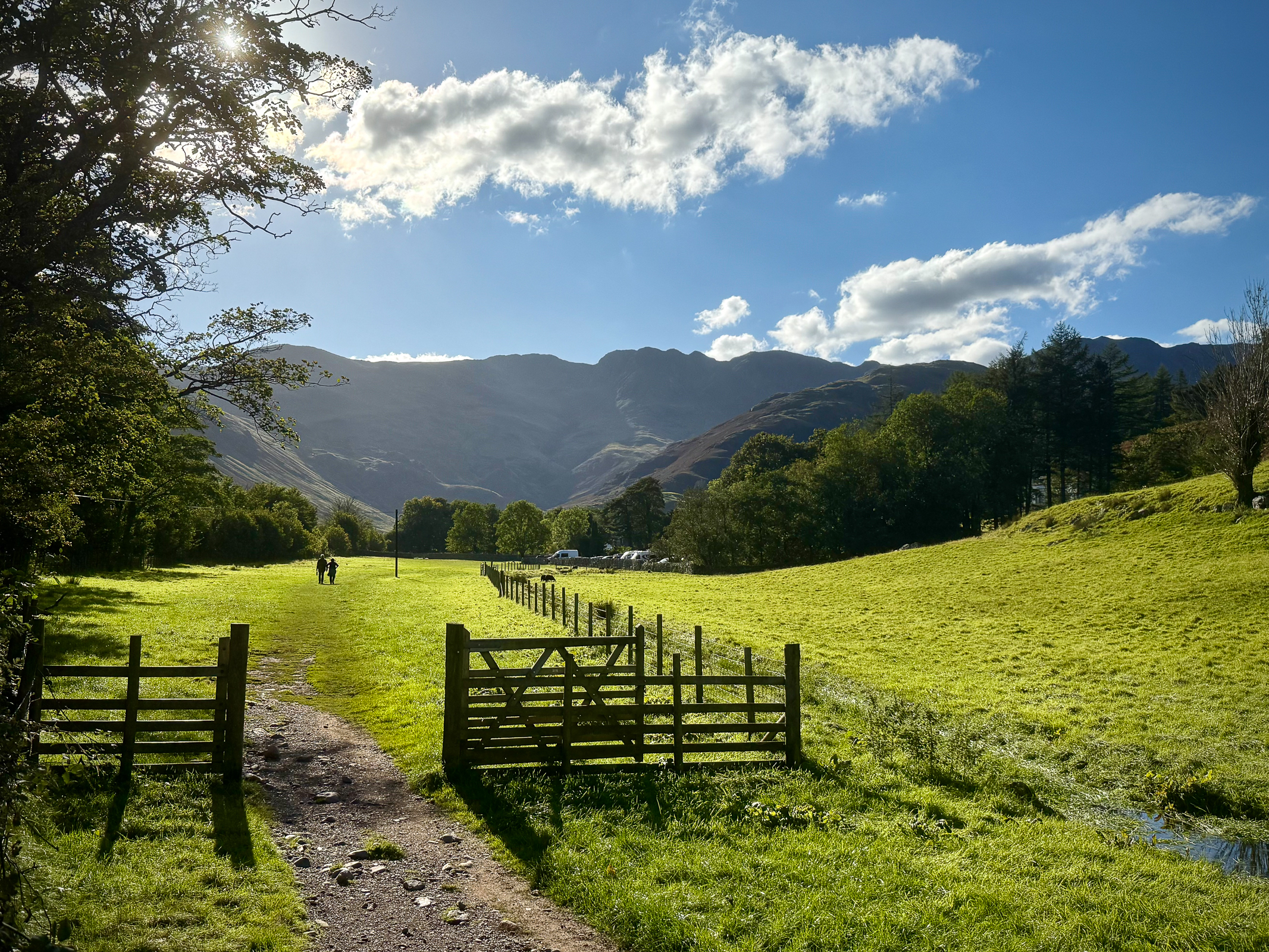
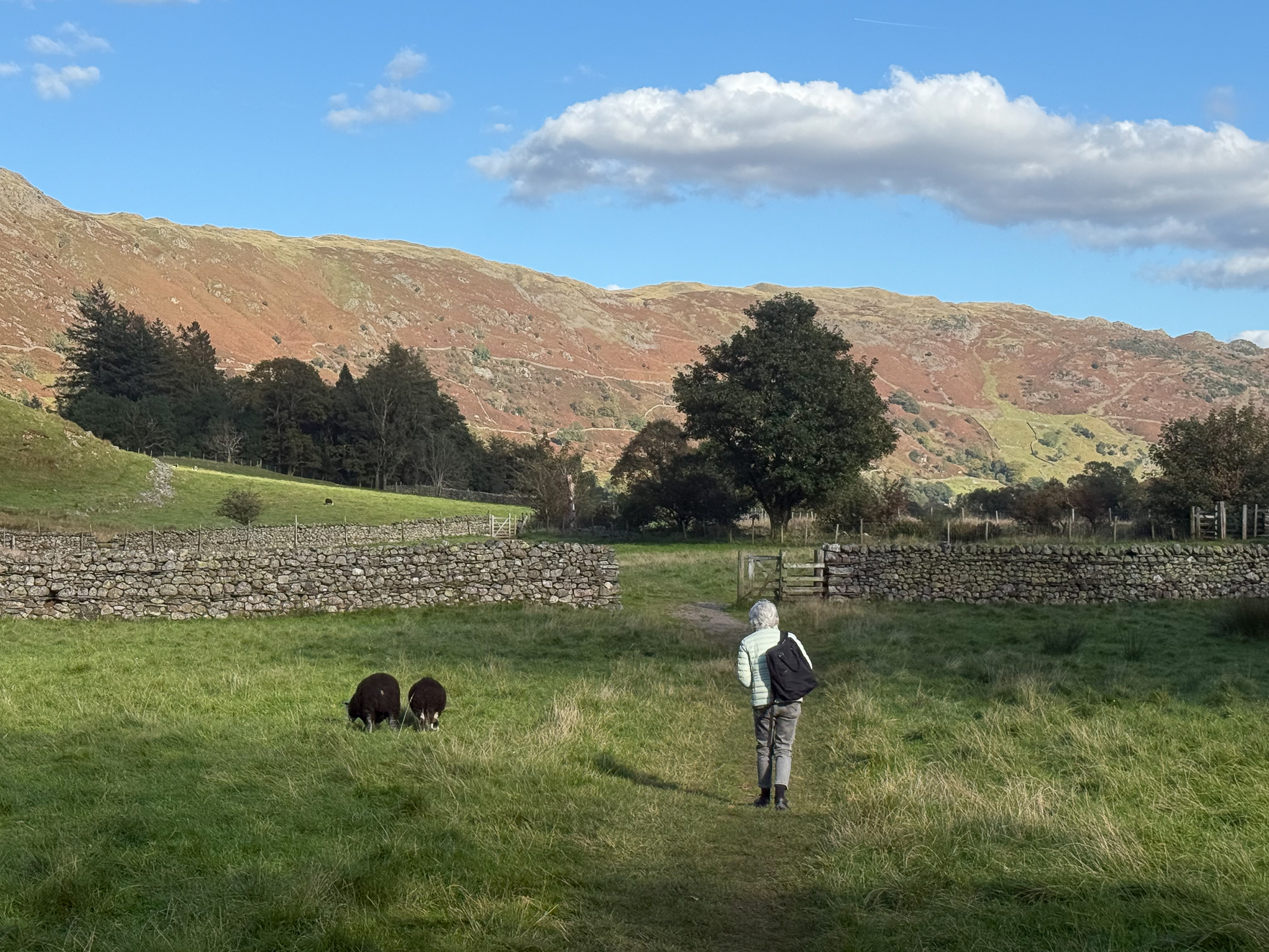
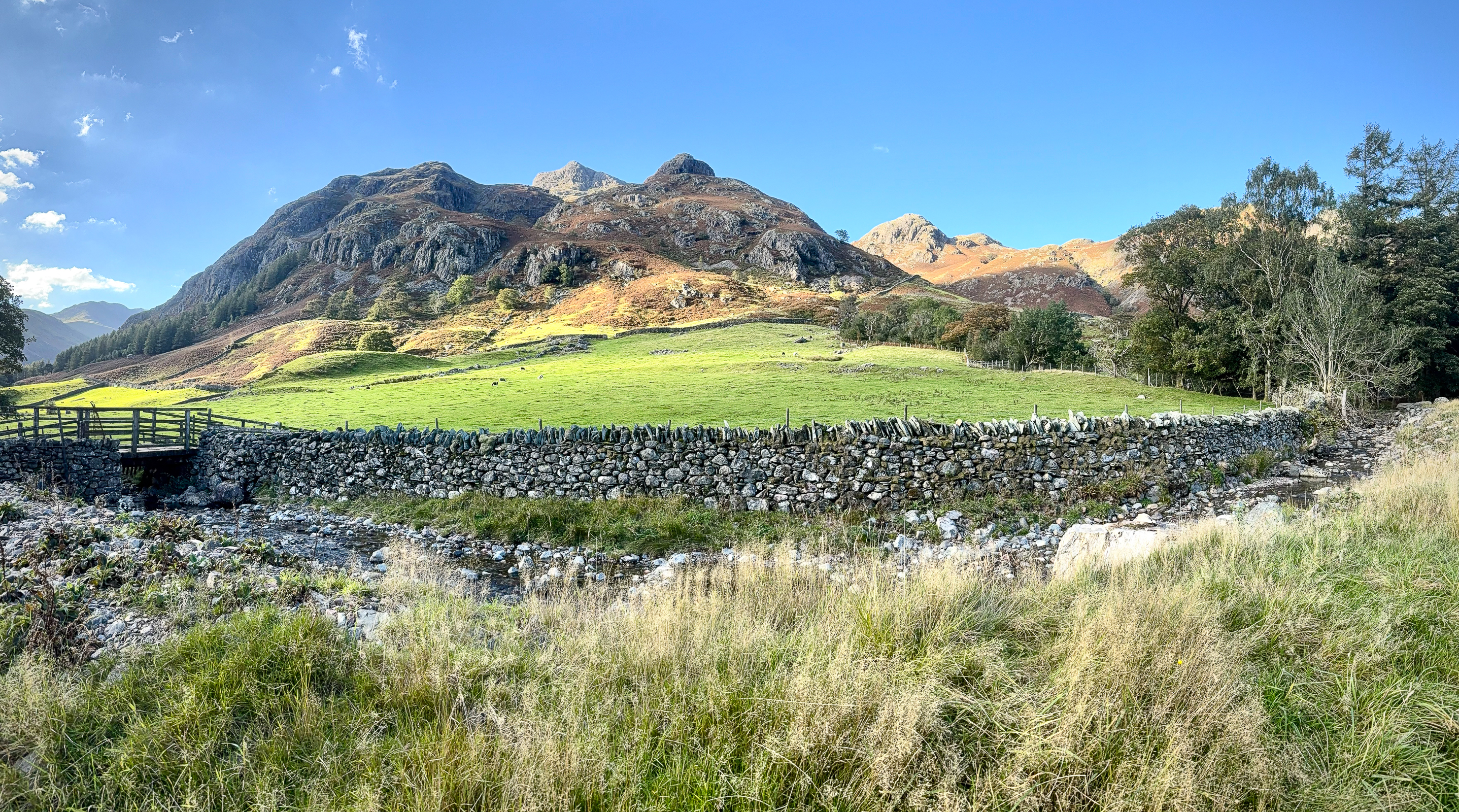
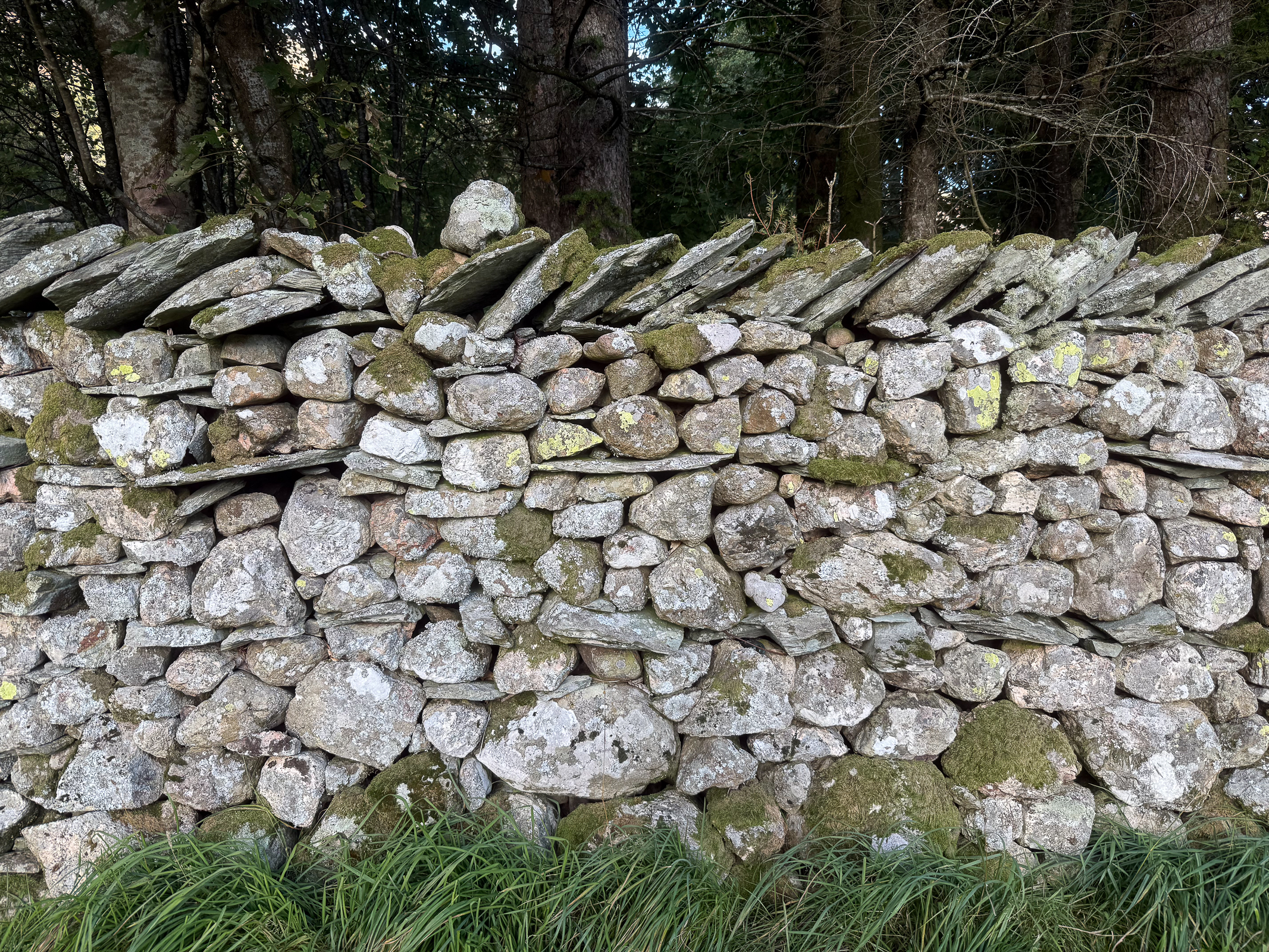
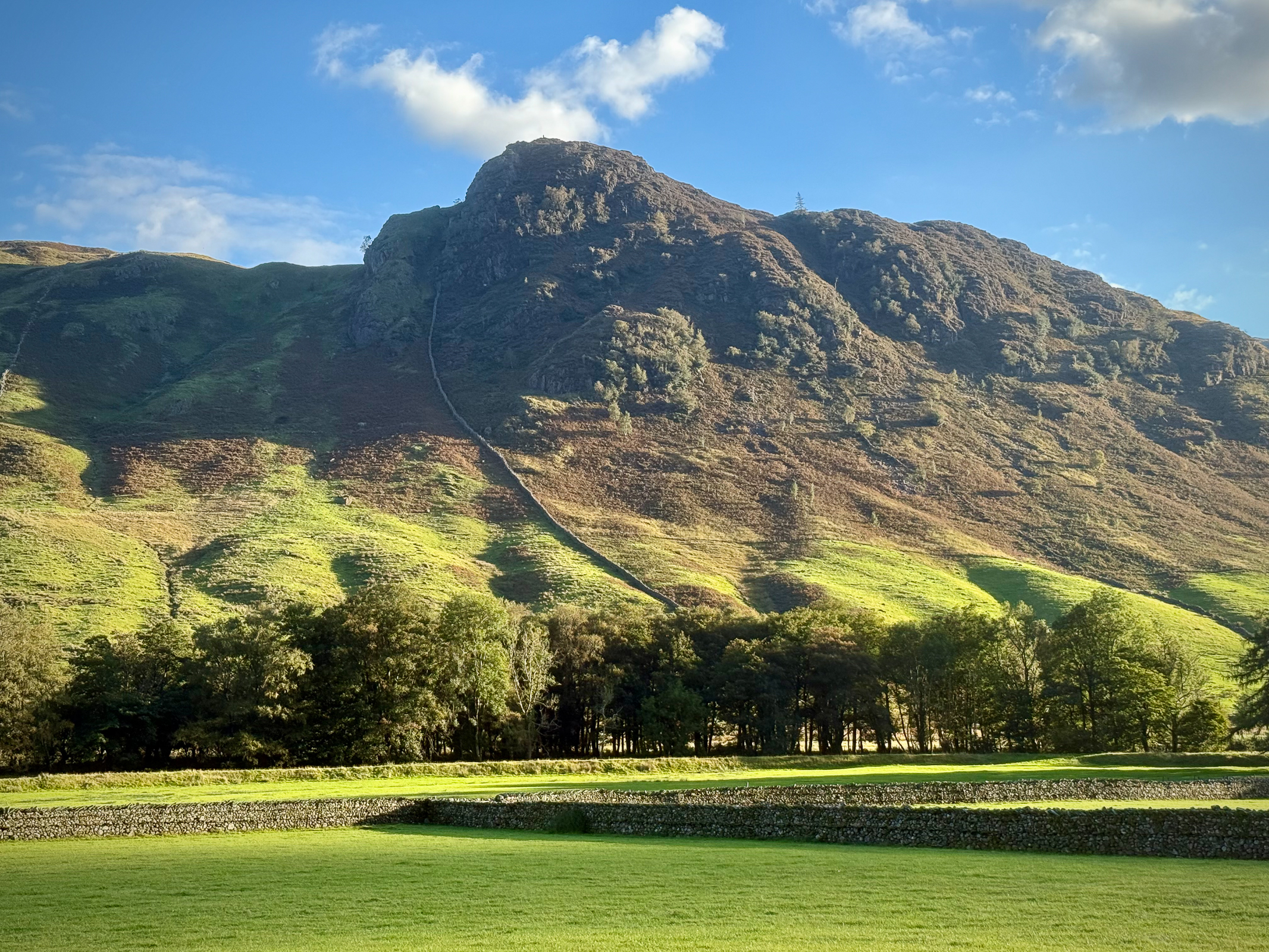
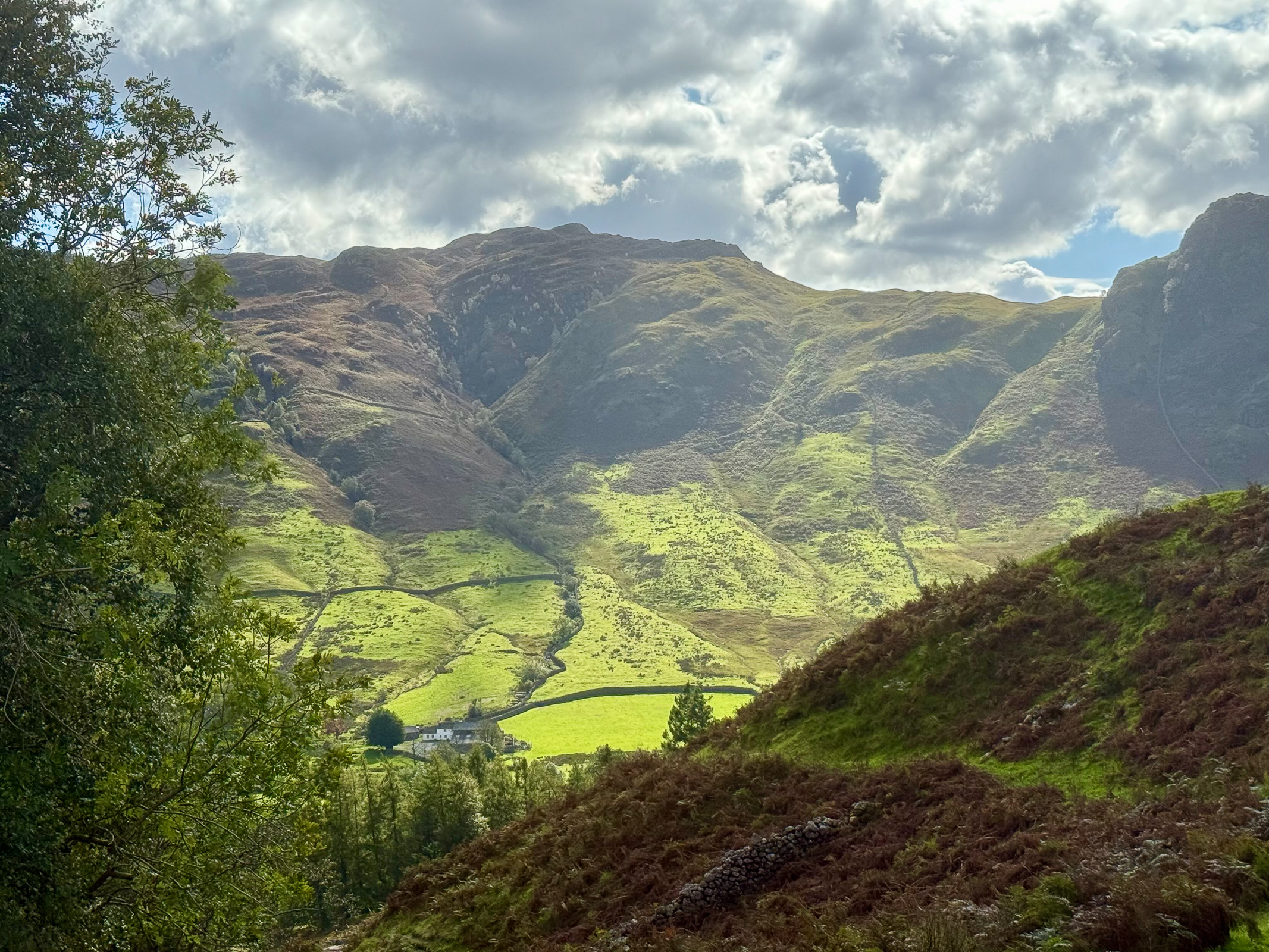
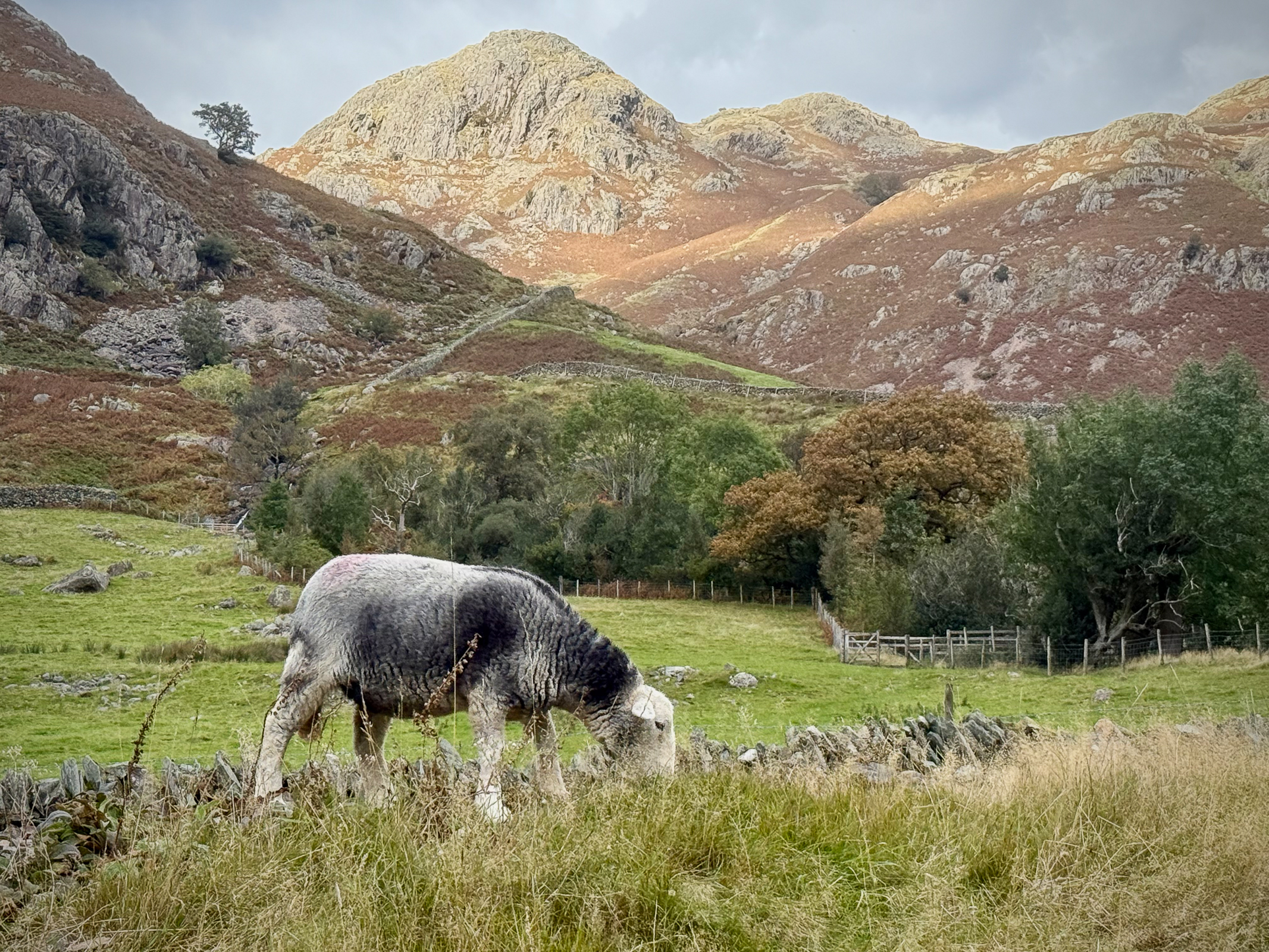
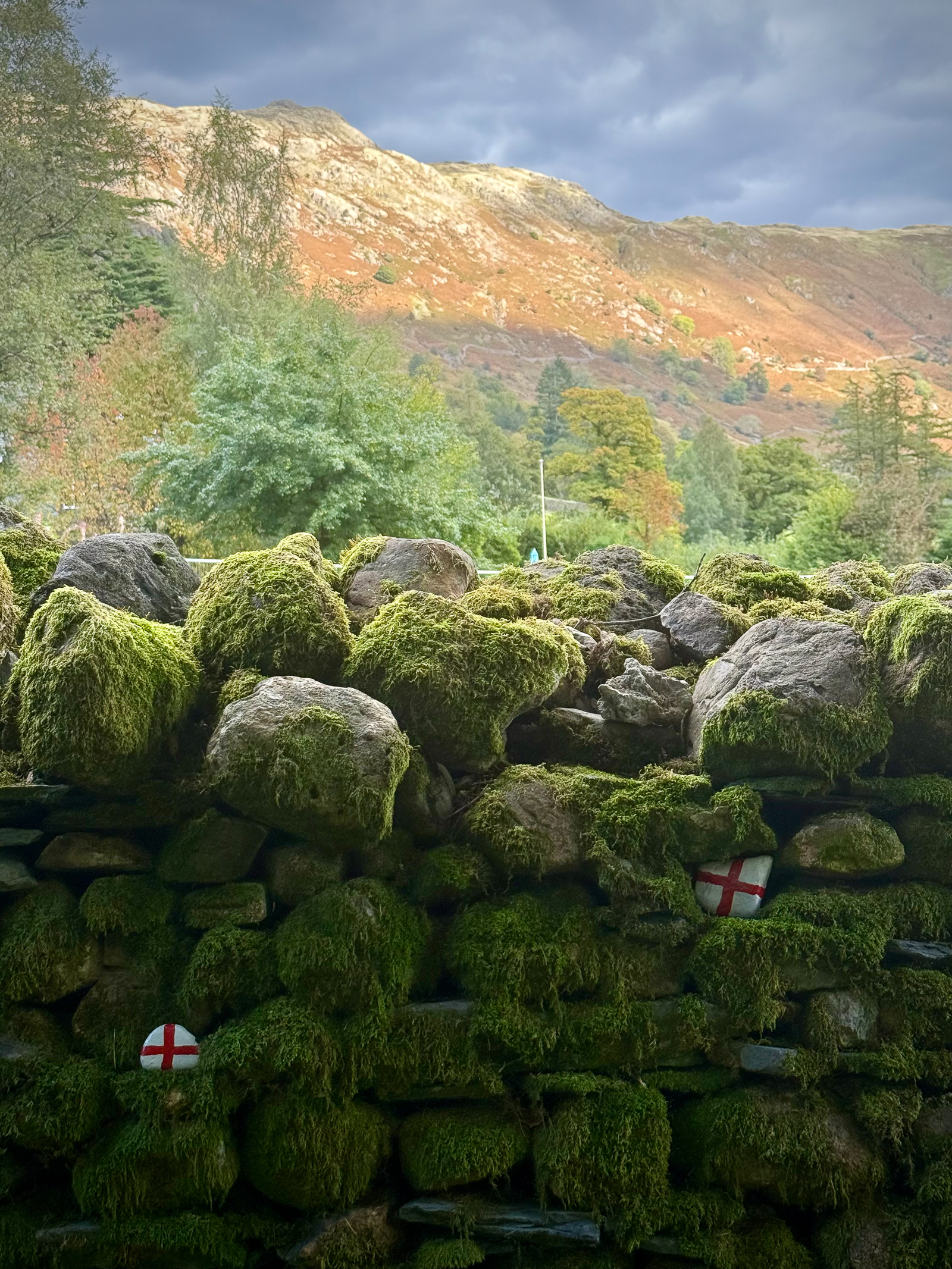
We spent two nights at the Old Dungeon Ghyll Hotel in the Great Langdale Valley of the Lake District National Park. Since 2017, this area has been a UNESCO World Heritage Site, in recognition of its unique hill-farming culture. In the morning, we hiked up most of the way to Stickle Tarn and Bright Beck, a little jewel of a lake. It was located above the by, in a thwaite, by the beck, and from it came a beautiful mountain gill. A ring garth separated the inbye land from the fell side. The connected valleys of Great Langdale and Little Langdale take their name from the Old Norse for “long valley”.
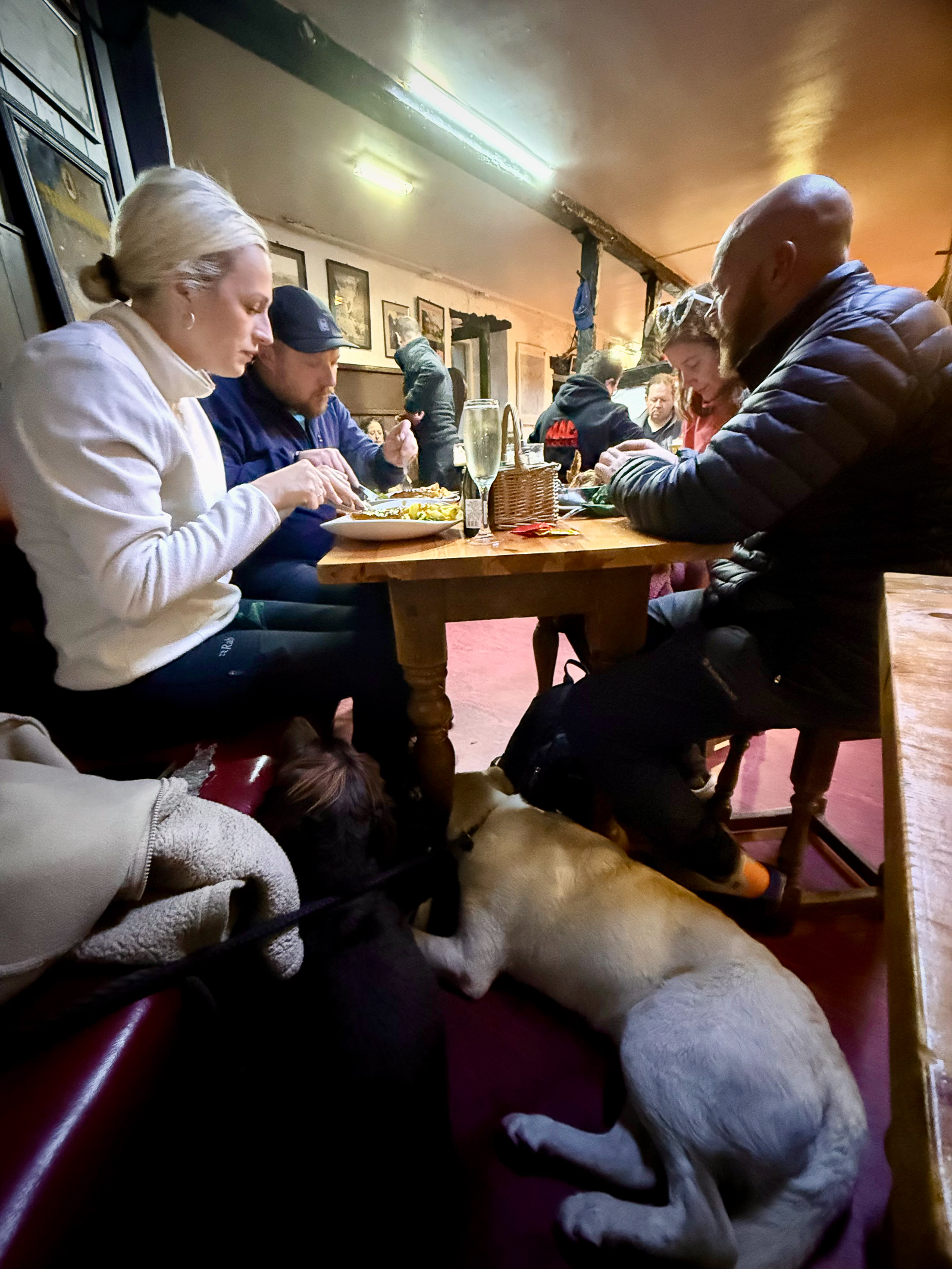
Our hotel was located on a site that has been occupied for 300 years. It was at the foot of the highest mountain in England, and serious hikers and climbers outfitted with serious equipment were taking advantage of this special place. It wasn’t crowded and it was dripping with history. Dinner at the Climbers Bar was a highlight. The meat pies were superb, the pints were great, and the toffee sticky pudding was simply the best I’ve ever had. We were fascinated by how the English (we were the only Americans) all had dogs, and brought them into the pub.
Historically, this area has been occupied for many thousands of years by many people including the Vikings, Celts, Romans, Normans, Welsh, Scots and English. Before the Norse settled here, Welsh was the language spoken in this area. The linguistic heritage from these people is astonishing and is especially felt in the beautiful place names of this remarkable place. Parts of the nearby contested border between England and Scotland were called the Debatable Lands and large clans of bandits called border reivers roamed this ungovernable area for hundreds of years until most of it was taken over by the king of England.
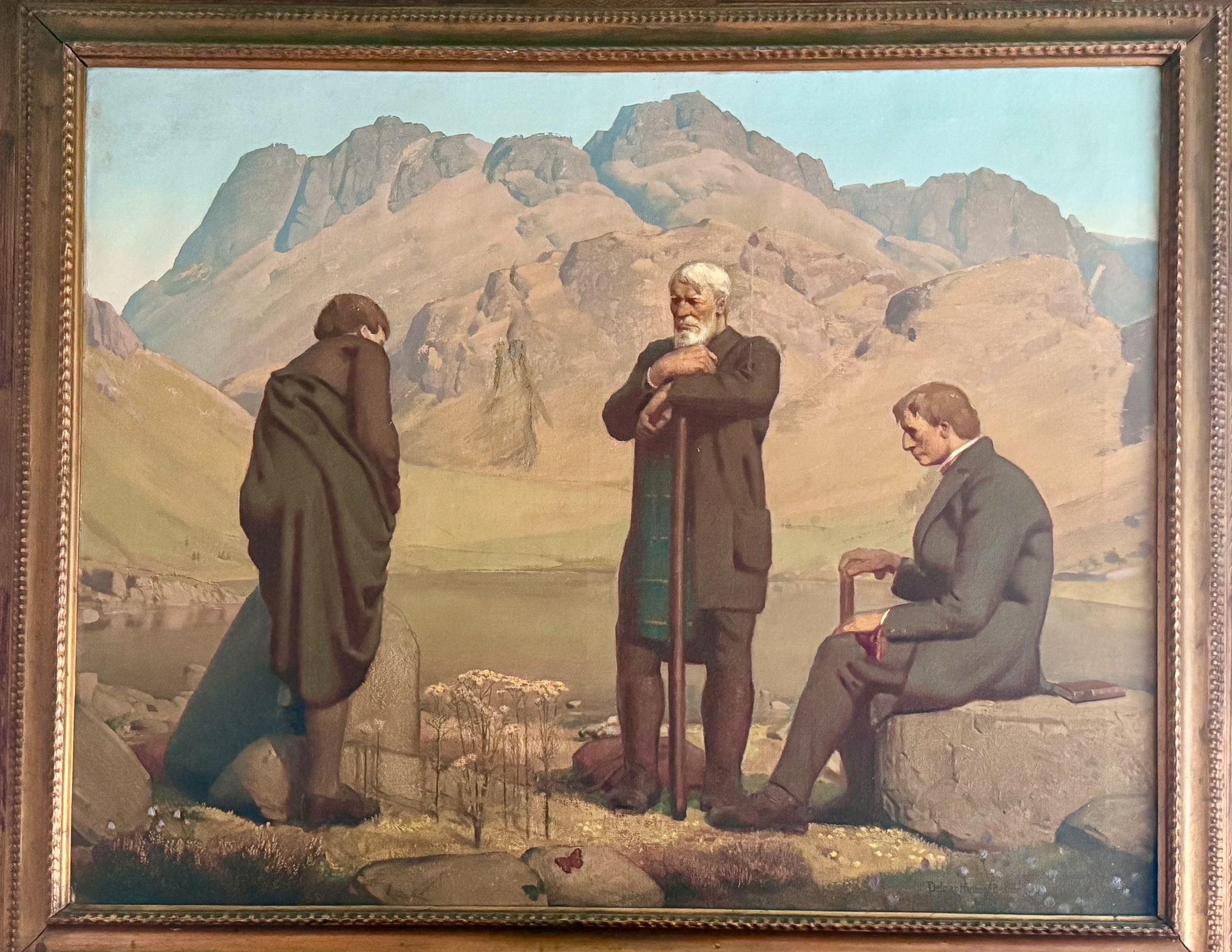
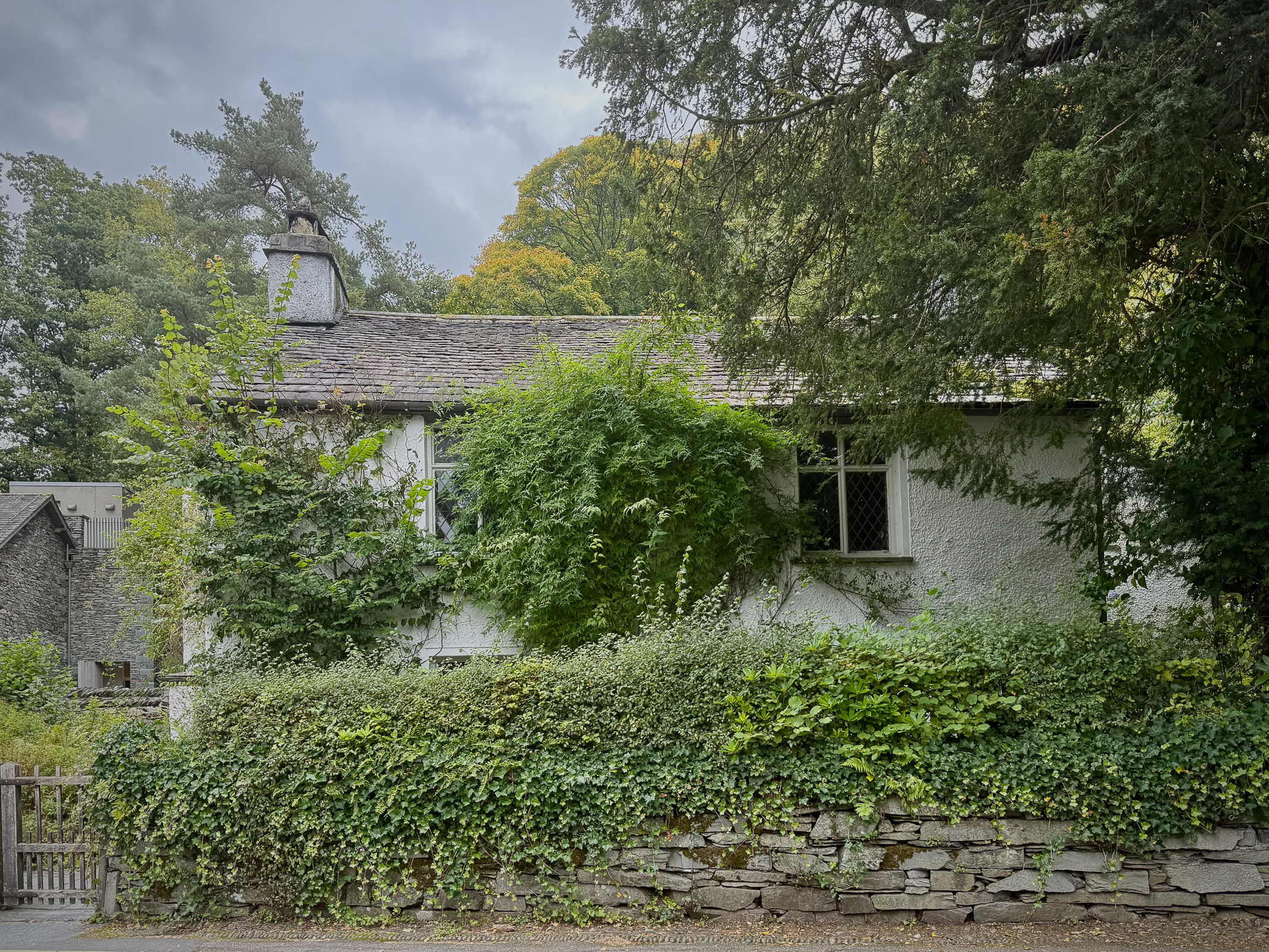
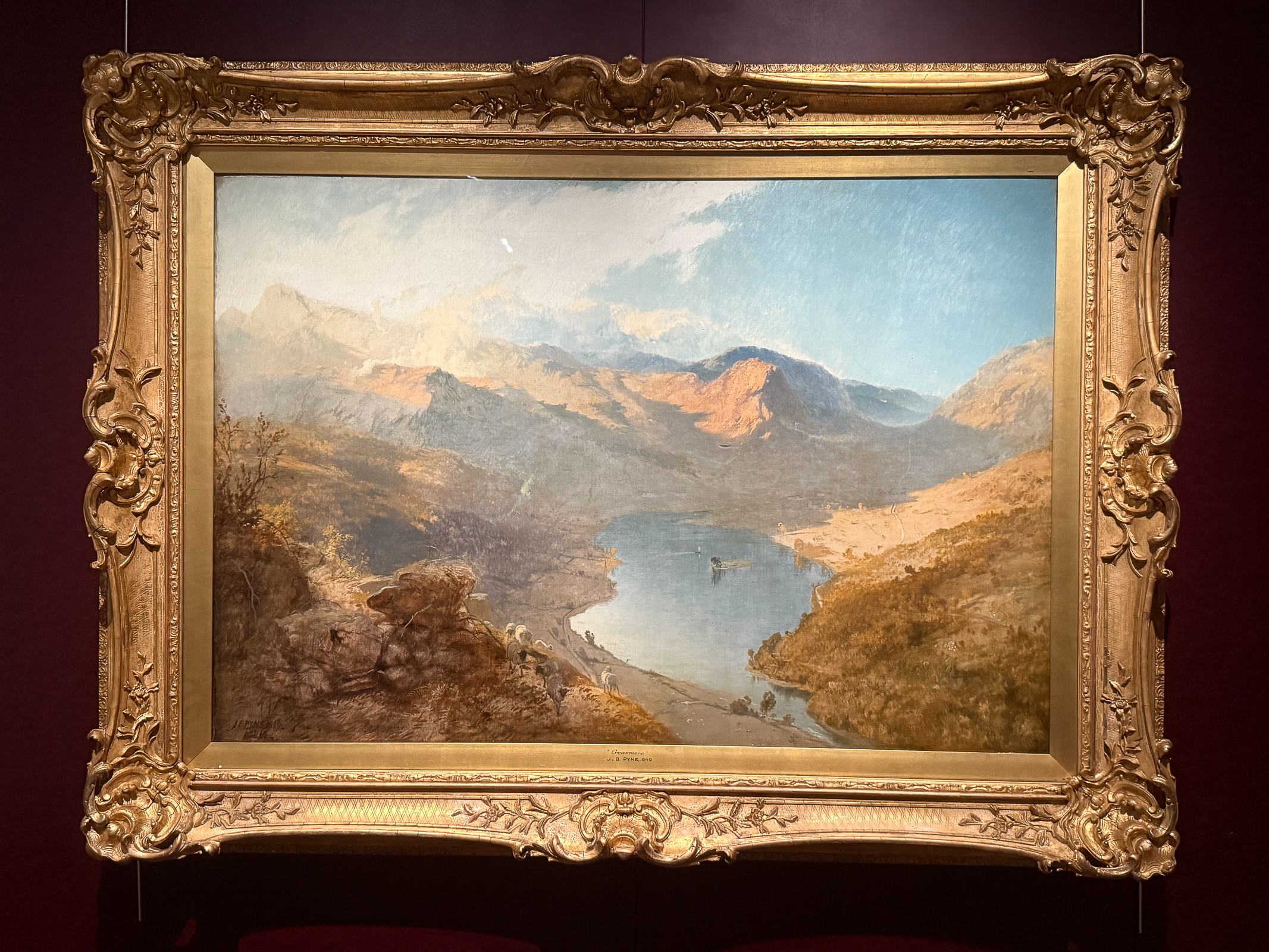
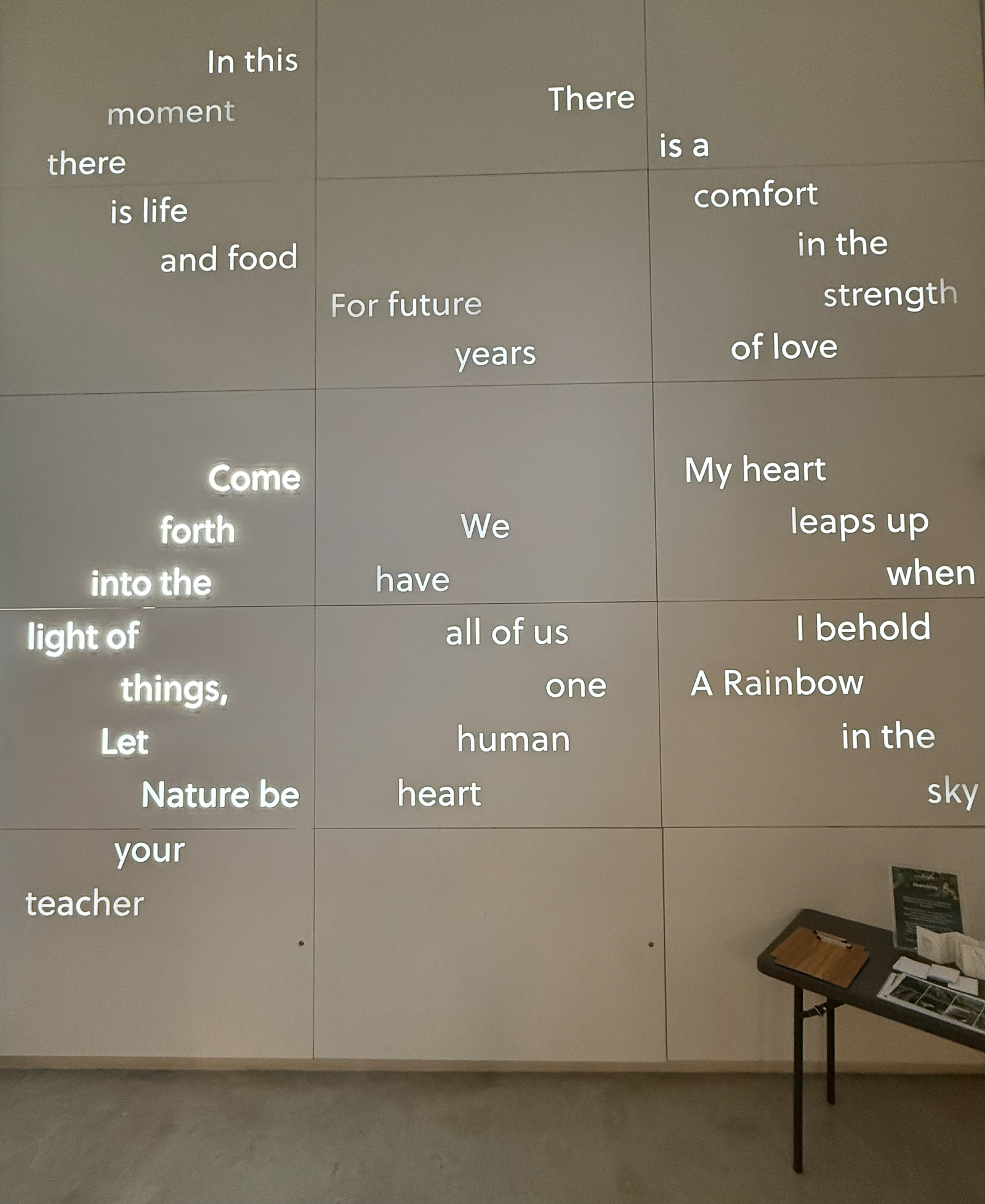
The famous English romantic poet William Wordsworth did much to increase the appreciation and protection of this lovely valley, writing about the Blea Tarn in his poem The Excursion and Dungeon Ghyll in The Idle Shepherd Boys. Wordsworth was a poet who helped launch the Romantic Age in English literature and remains one of the most recognizable names in English poetry. His work emphasized a deep connection and admiration with the natural world and the working people of this area. The little village of Grasmere has an illustrious literary heritage. We made a pilgrimage here to Wordsworth’s home called Dove Cottage where he wrote much of his early poetry. It was stirring to see where he wrote his formative work while he lived in this tiny, cramped cottage with his large family.
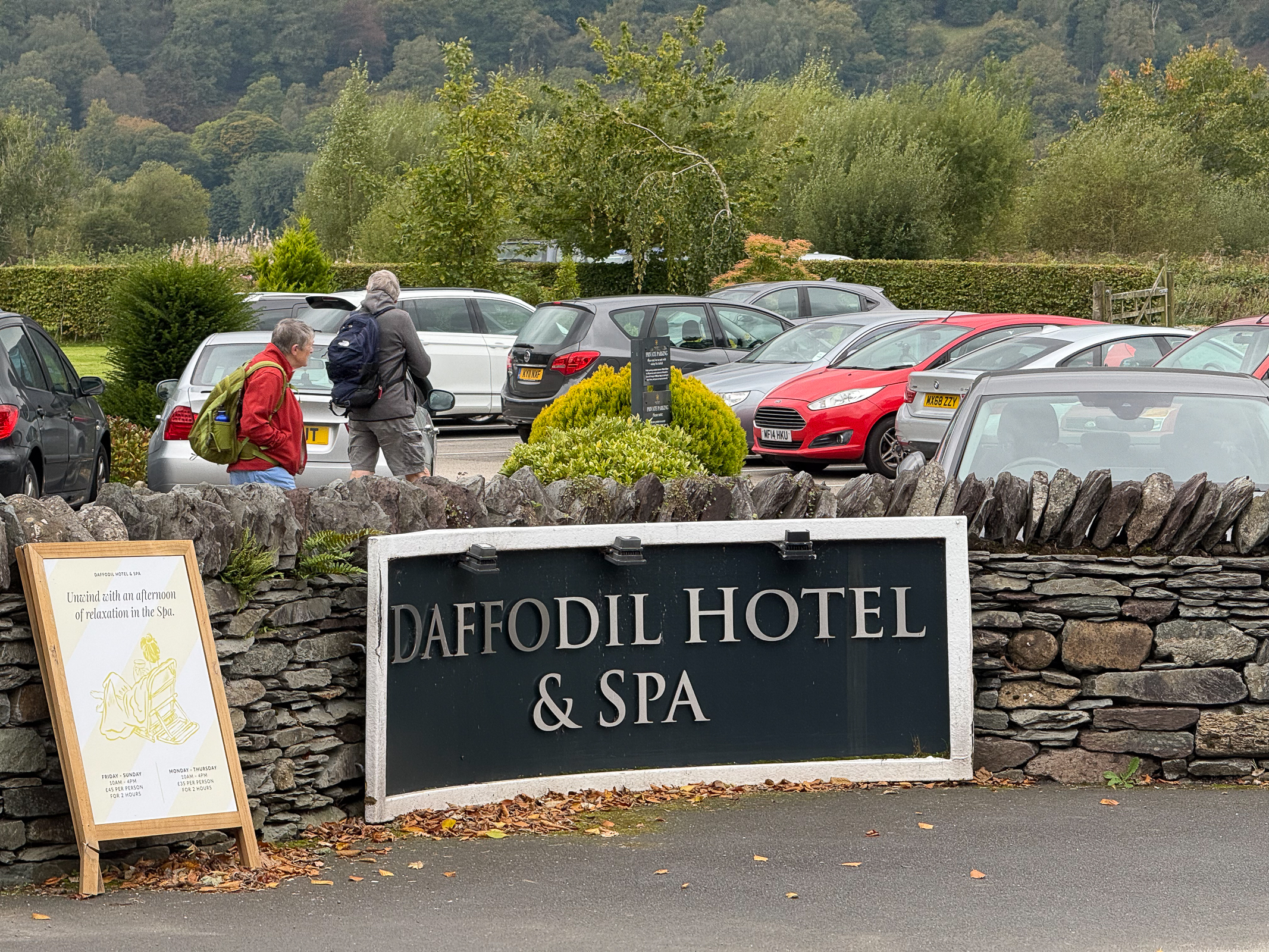
It was sad to see how the nearby villages of Ambleside and Windermere have become crowded, exclusive, over commercialized tourist-traps. Like Thoureau’s Walden Pond in Massachusetts, a place that had attracted creative artists seeking solitude has now become overrun by admiring fans and rapacious capitalism. Perhaps it speaks to a need for many to connect with something real rather than virtual. Certainly, the physical beauty here is astonishing and the literary legacy is inspiring. But I was happy to lose the crowds in our rear-view mirror and be far from the maddening crowd.
As we left the Lake District, the last place we visited was the Castlerigg Stone Circle, which is part of the English National Trust. Built over 4,500 years and like the better-known Stonehenge in southern England, this quiet magical place only reinforced our fascination with this mysterious and beautiful part of England.
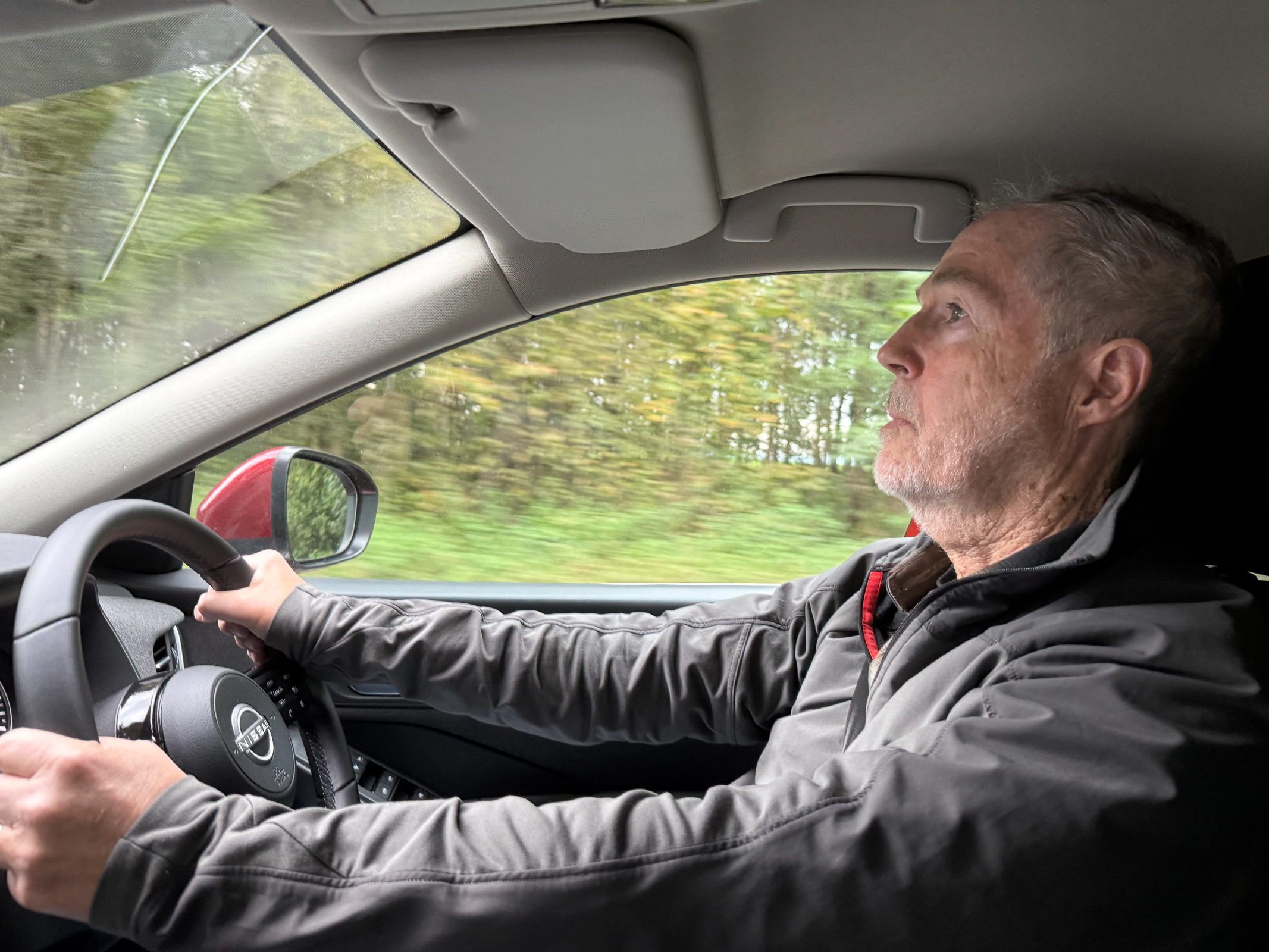
Driving the medieval and impossibly narrow roads of the Lake District was part of my cruel initiation into motoring in England. Ellen said she almost threw up as our oversized car scrapped against the hedges and ancient rock walls as other oversized cars, trucks and busses were barreling in the other direction inches from my face. All of this while driving on the wrong side of the road. I still hold on to the steering wheel with my two-fisted, white-knuckled death grip, but, despite a few close calls, I am gradually feeling more comfortable while driving in England. Miles to go before we sleep…
For twelve days, we drove over 3,700 miles with our pedal to metal zooming across the country. Then we stopped at our place in Vermont, for six weeks! Going from full speed to full stop takes a little adjustment. But we quickly appreciated leaving behind the corporate American road culture and savored the beauty of the New England landscape.
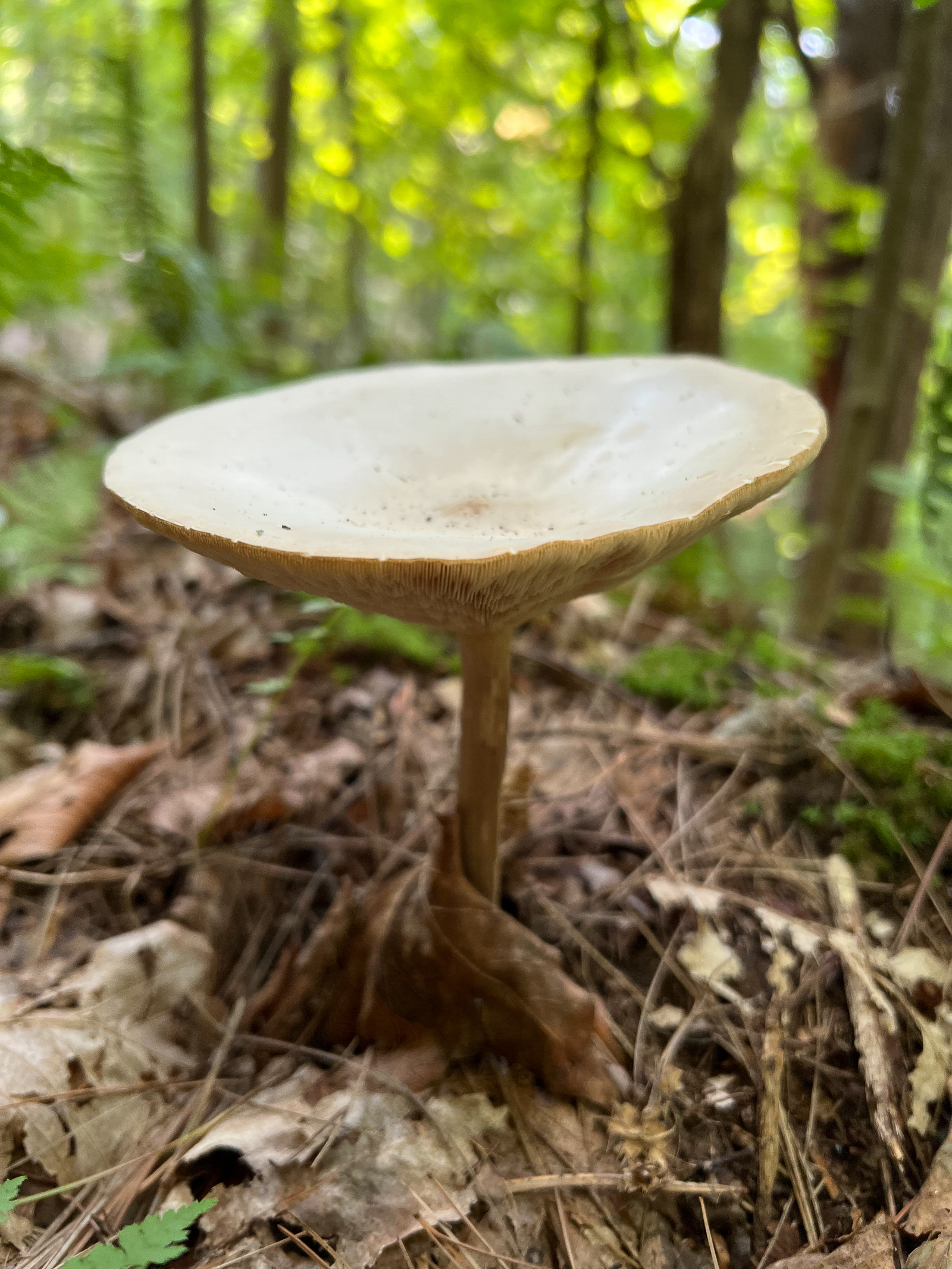
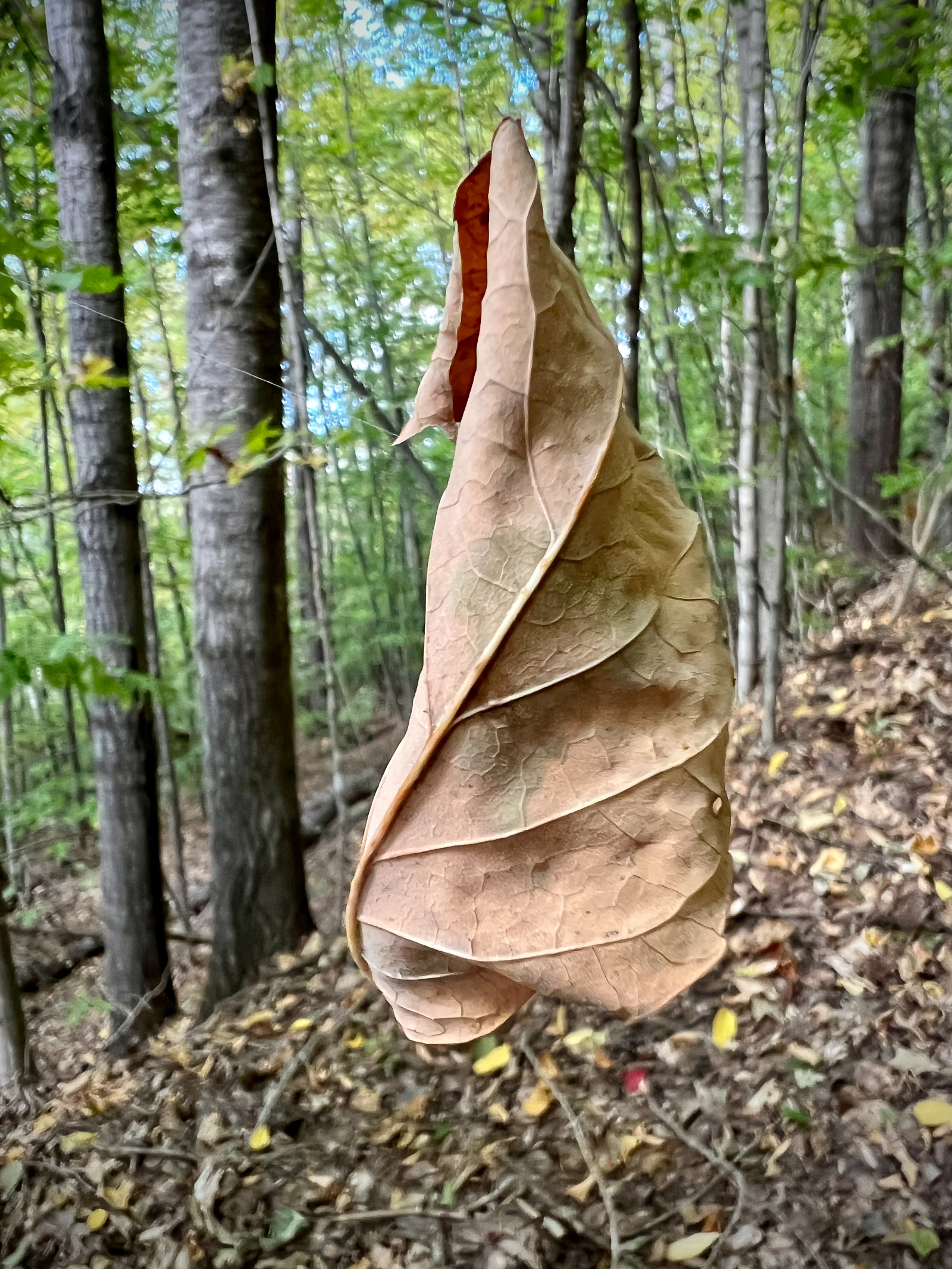
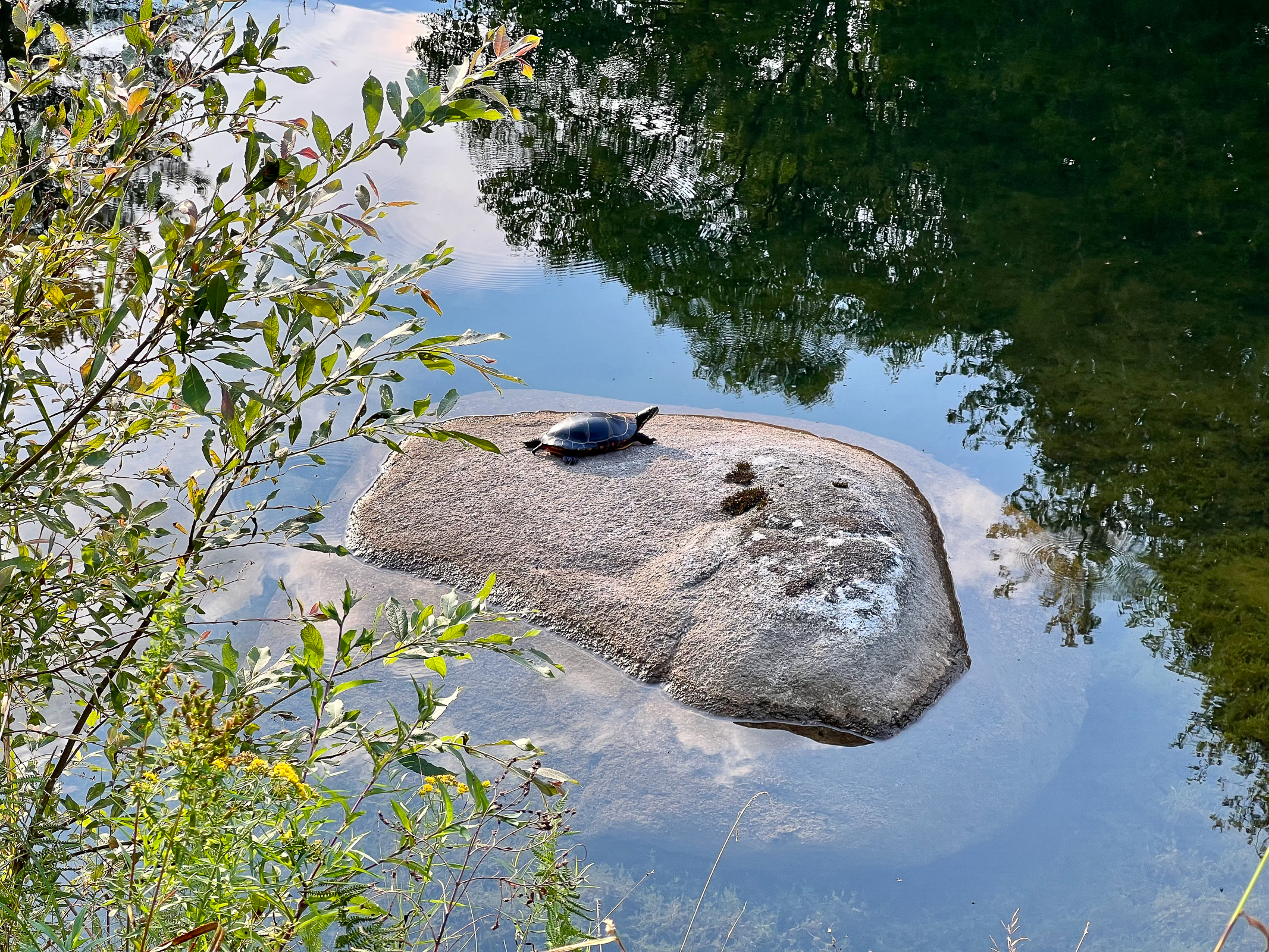
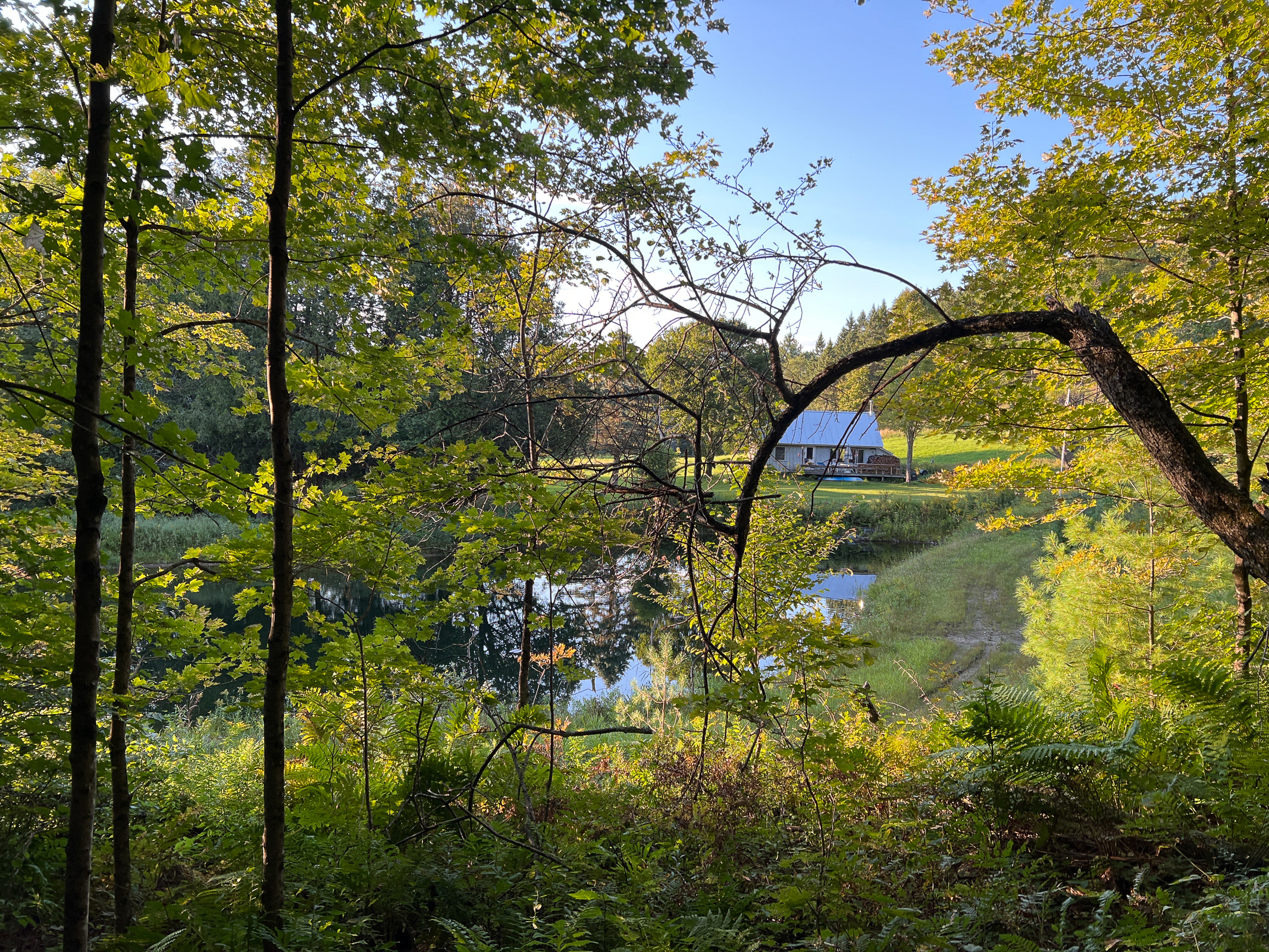
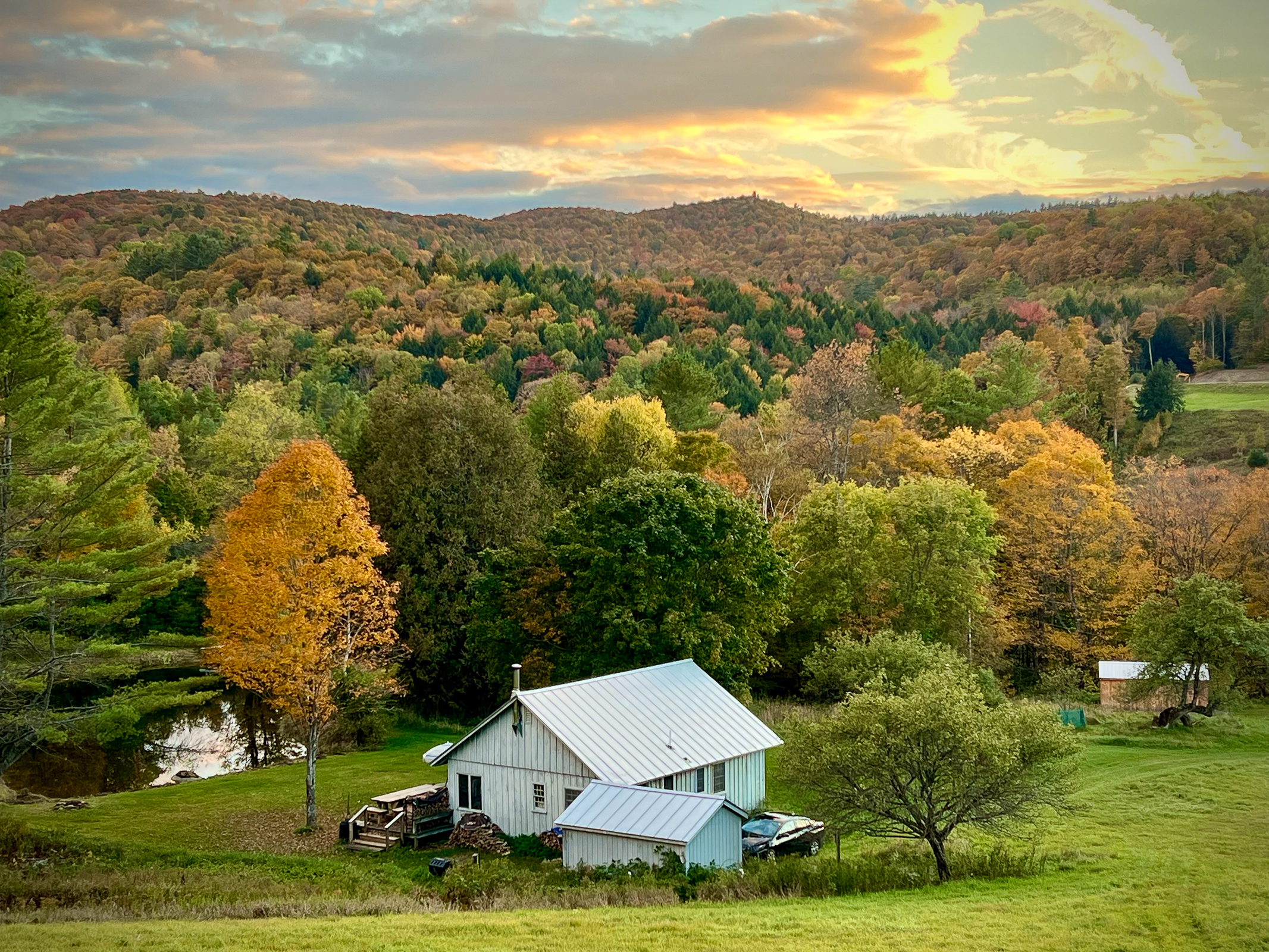
We share 53 acres and a small cabin with two other families in the Vermont woods on a dirt road off a dirt road off a dirt road. One of the great pleasures for a life-long Californian like me is plopping myself into this totally different world. Vermont is a biological transition zone between the boreal forests of the north and the southern deciduous forests. Seventy-eight percent of the state is forested, and that land contains a huge number of animal and plant species. One of the first things we did after arriving was to go hike in the woods. Every year, I am always surprised by the abundance and diversity of life in these woodlands.
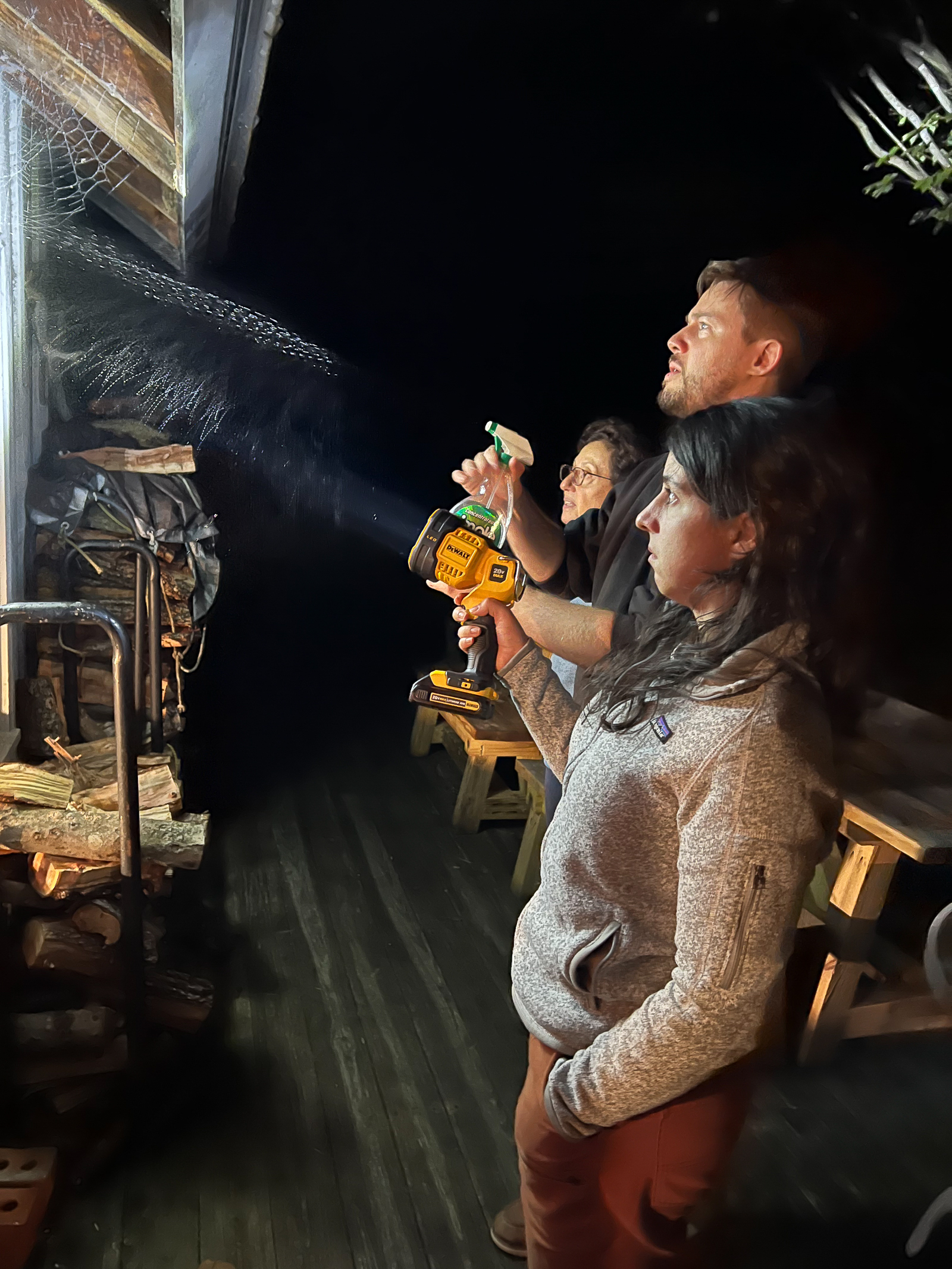
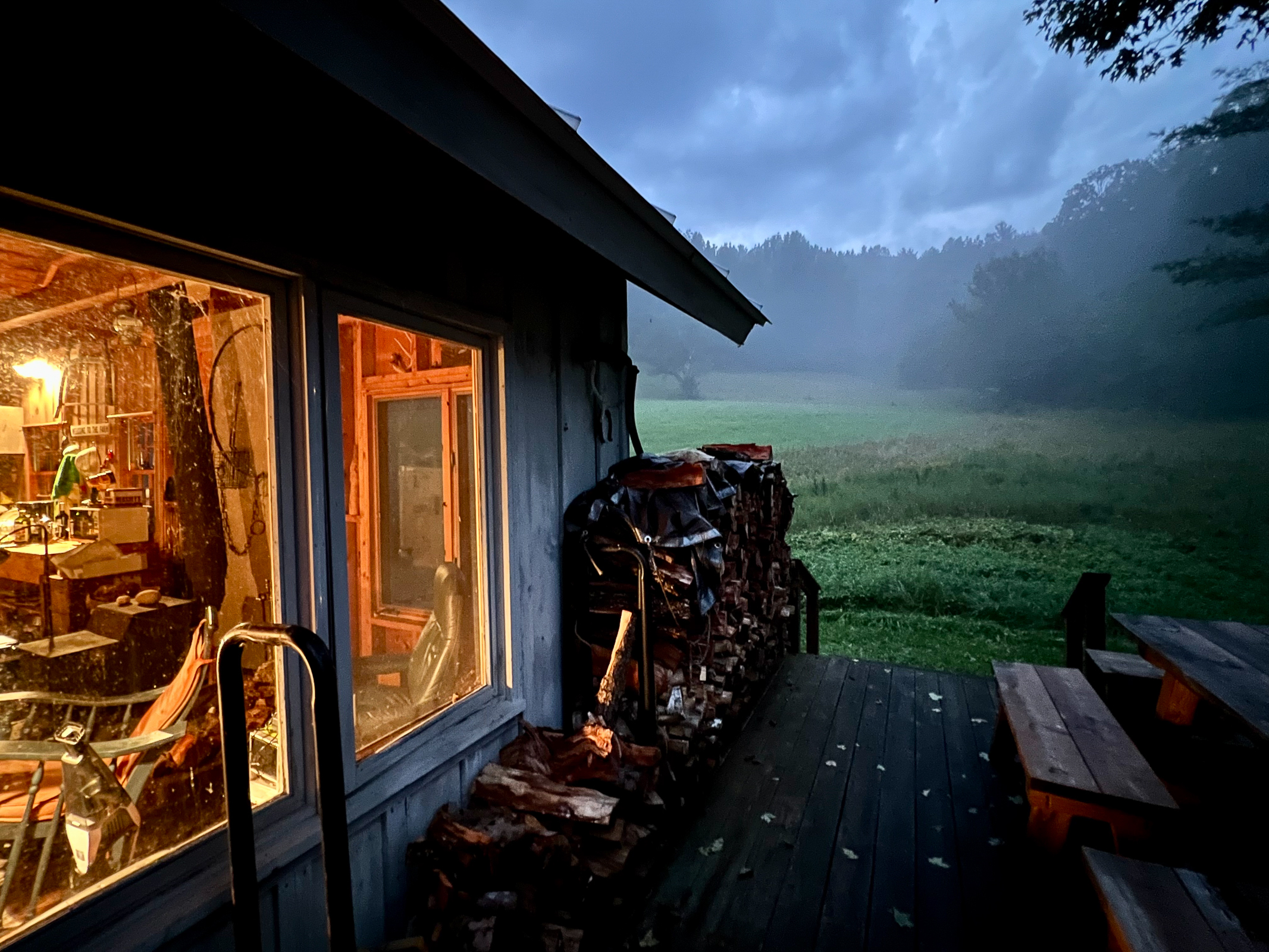
Sometimes nature’s exuberance can be a little annoying. One year we arrived from California just after a colony of wasps had built a GIANT nest right under the wooded deck that we used to enter the house. We can laugh about it now, but at the time it was no fun. This year, a large group of orb weaver spiders decided to spin their webs outside one corner of the cabin. Their prodigious work was astonishing to see. We read that spraying vinegar was a sure-fire way to get rid of them. Unfortunately, the spiders had not read that memo and stuck around for several more nights until they got tired of being drenched.
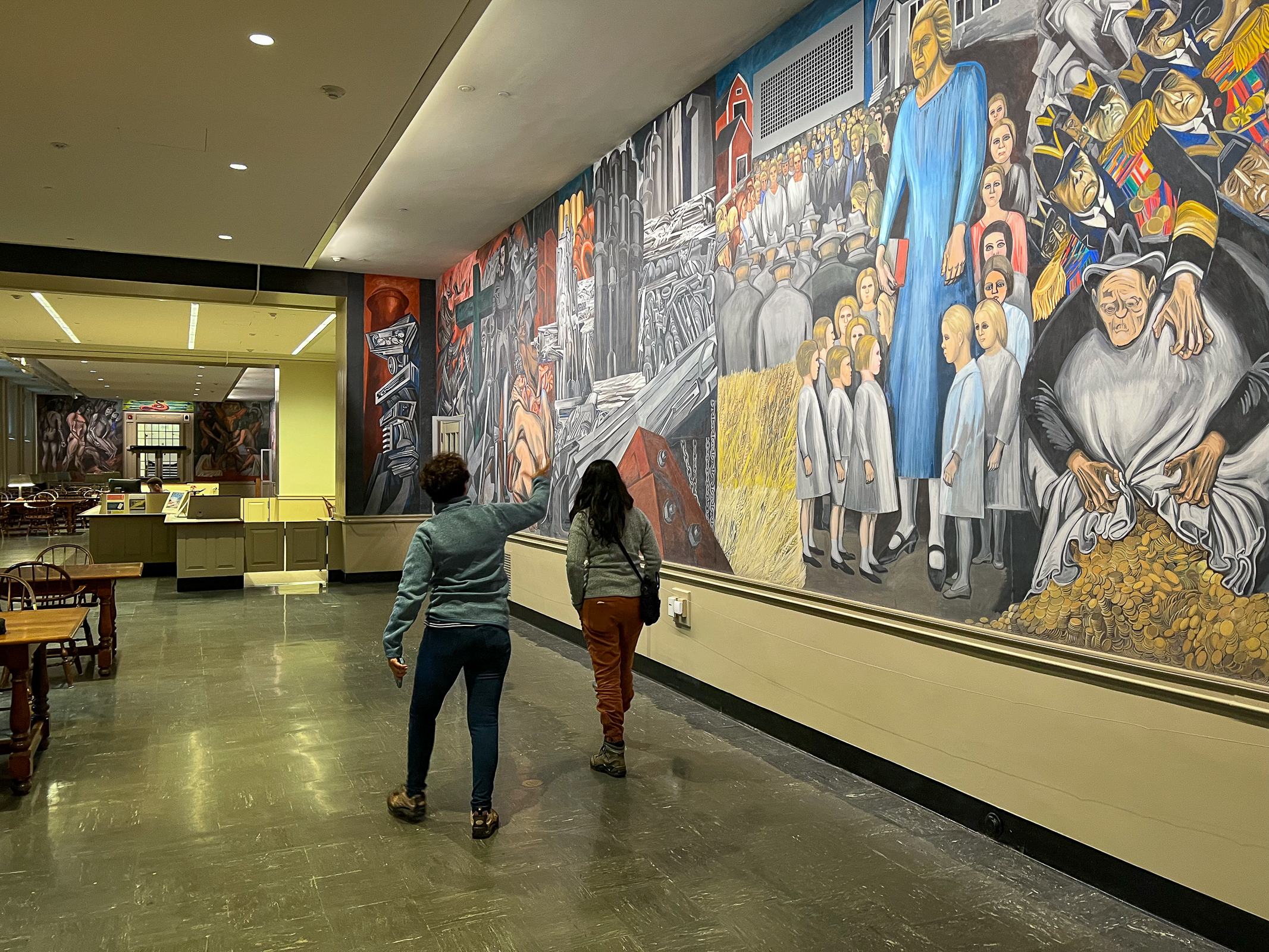
Shortly after we arrived, Walker and his girlfriend Rosa arrived from San Francisco and Rosa’s Mom Paulina arrived from Mexico City. It was Paulina’s first time in this part of New England, and we felt honored to show her around here after she had shown us around parts of Central Mexico and the Yucatan in 2023. One of the great cultural highlights in this region is Dartmouth College in nearby Hanover, NH. One of the great sites on campus is the Orozco Mural painted in the 1930s by the famous Mexican muralist Jose Clemente Orozco. It is now a National Historic Landmark.
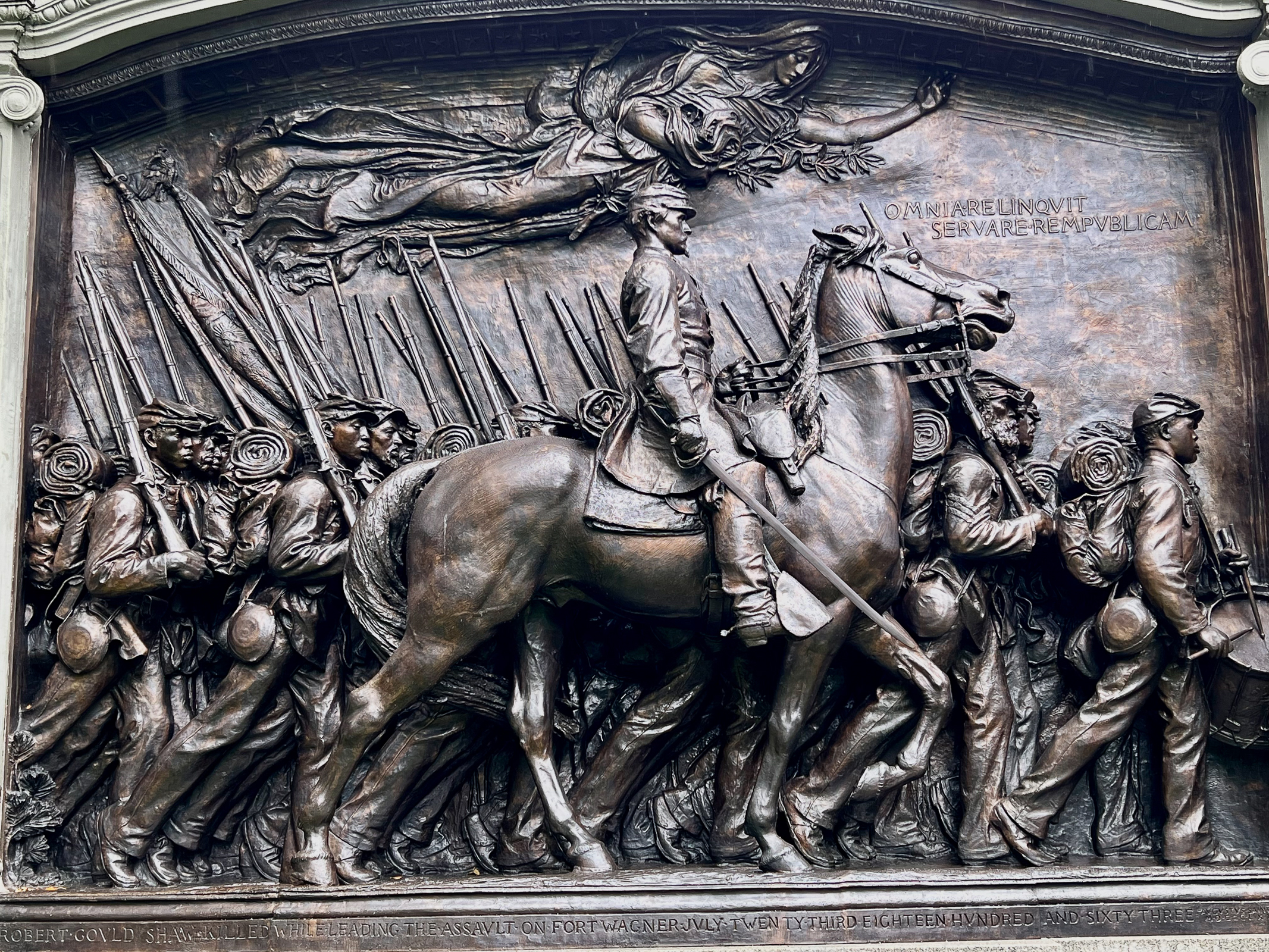
We also traveled to New Hampshire’s Saint-Gaudens National Historic Park which preserves the home, garden and studios of Augustus Saint-Gaudens, one of America’s foremost late 19th and early 20th century sculptors. It too is a National Historic Landmark. We also wanted to show Paulina some of the unknown parts of New England such as a small, abandoned early 19th century cemetery near our property. It was moving to see the headstones of children that had died almost 200 years ago.
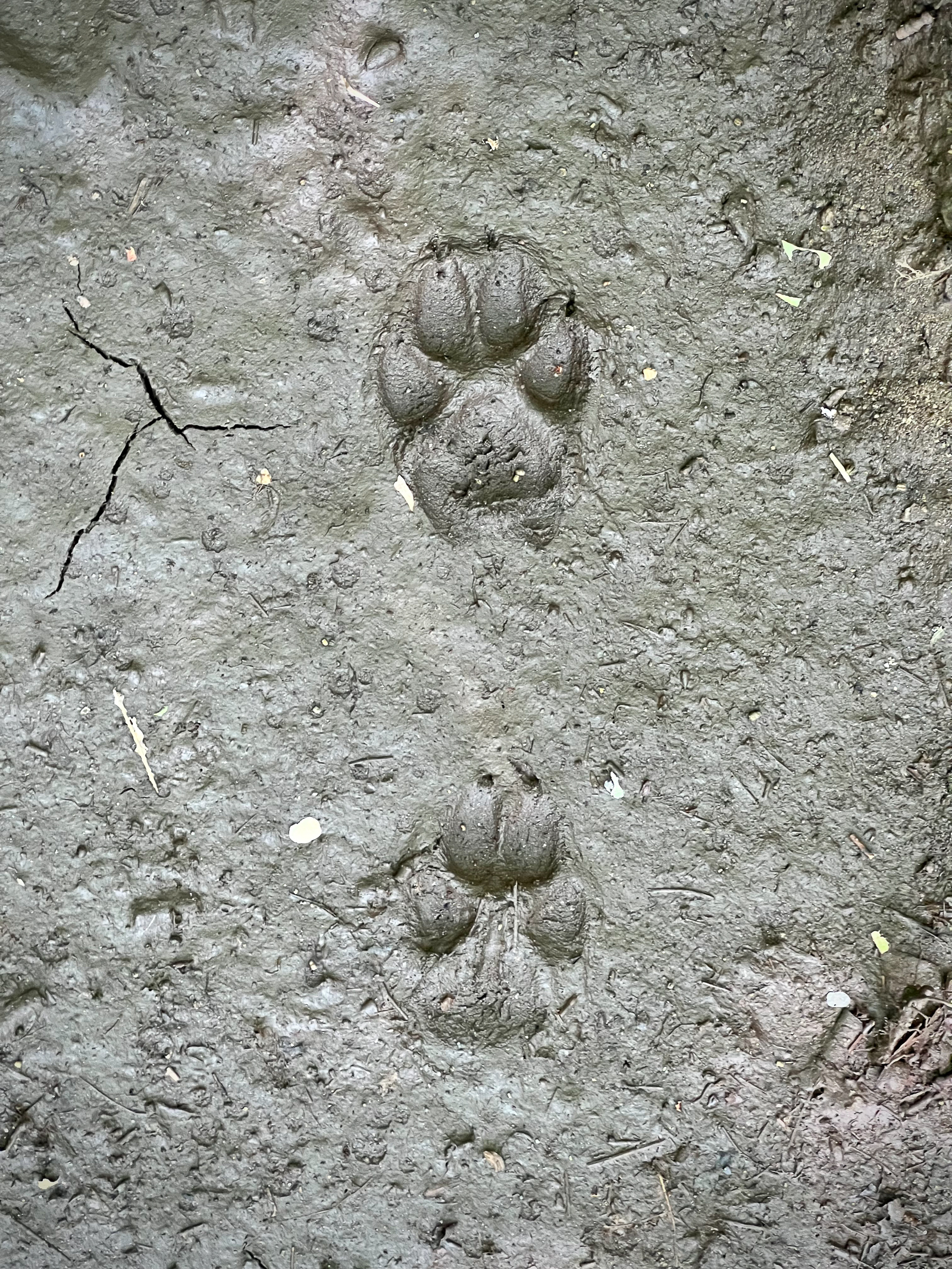
Mostly, we wanted to share the astonishing beauty of the New England forests. We spent many days being surprised and awed by nature as we hiked around the woods of Vermont.
After our epic day hikes, we would come back and watch the Democratic National Convention at night. Our heads were still spinning at all our country’s recent political developments, and it was fascinating to hear Paulina’s take on the state of American politics from a Mexican perspective.
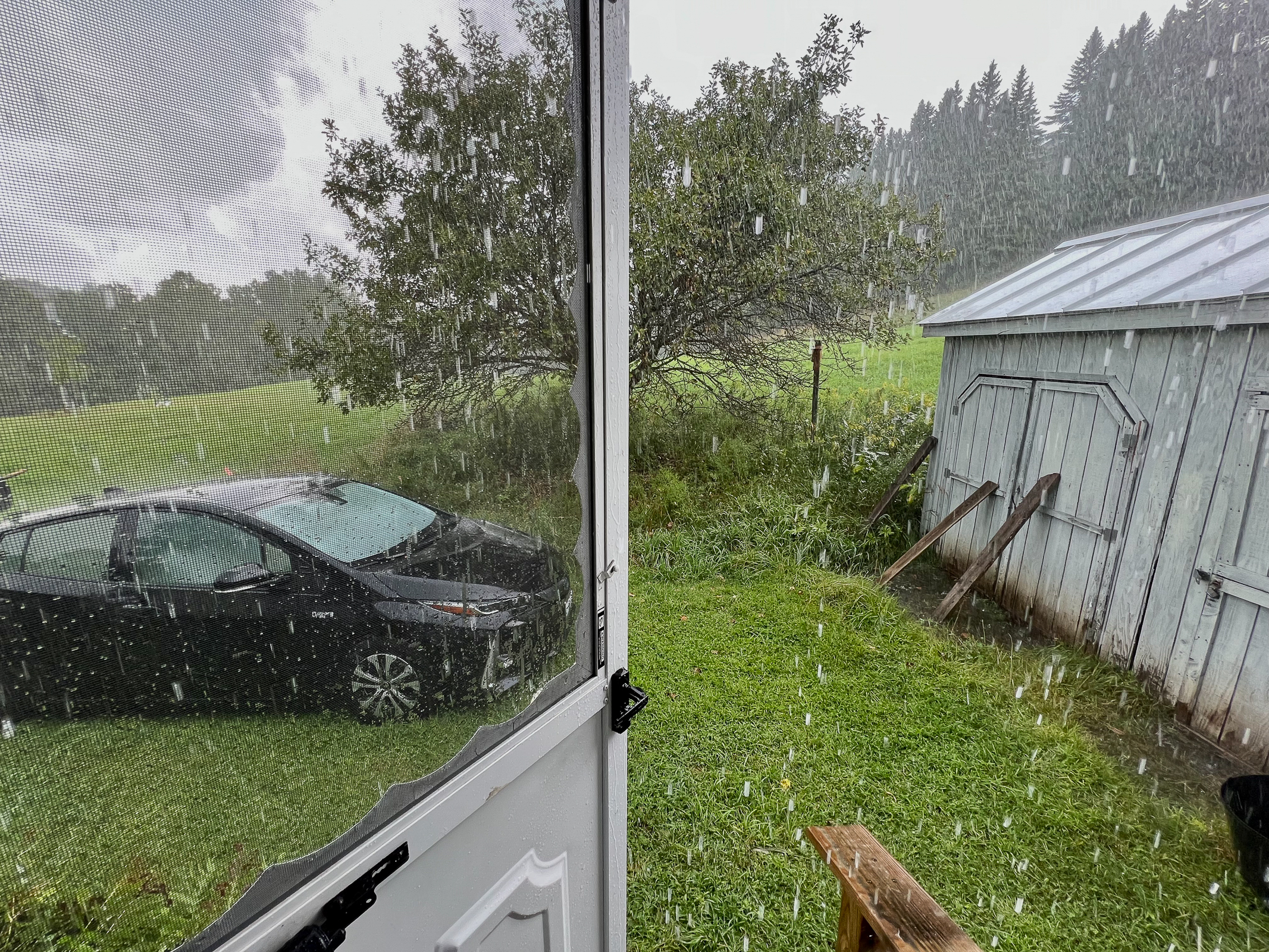
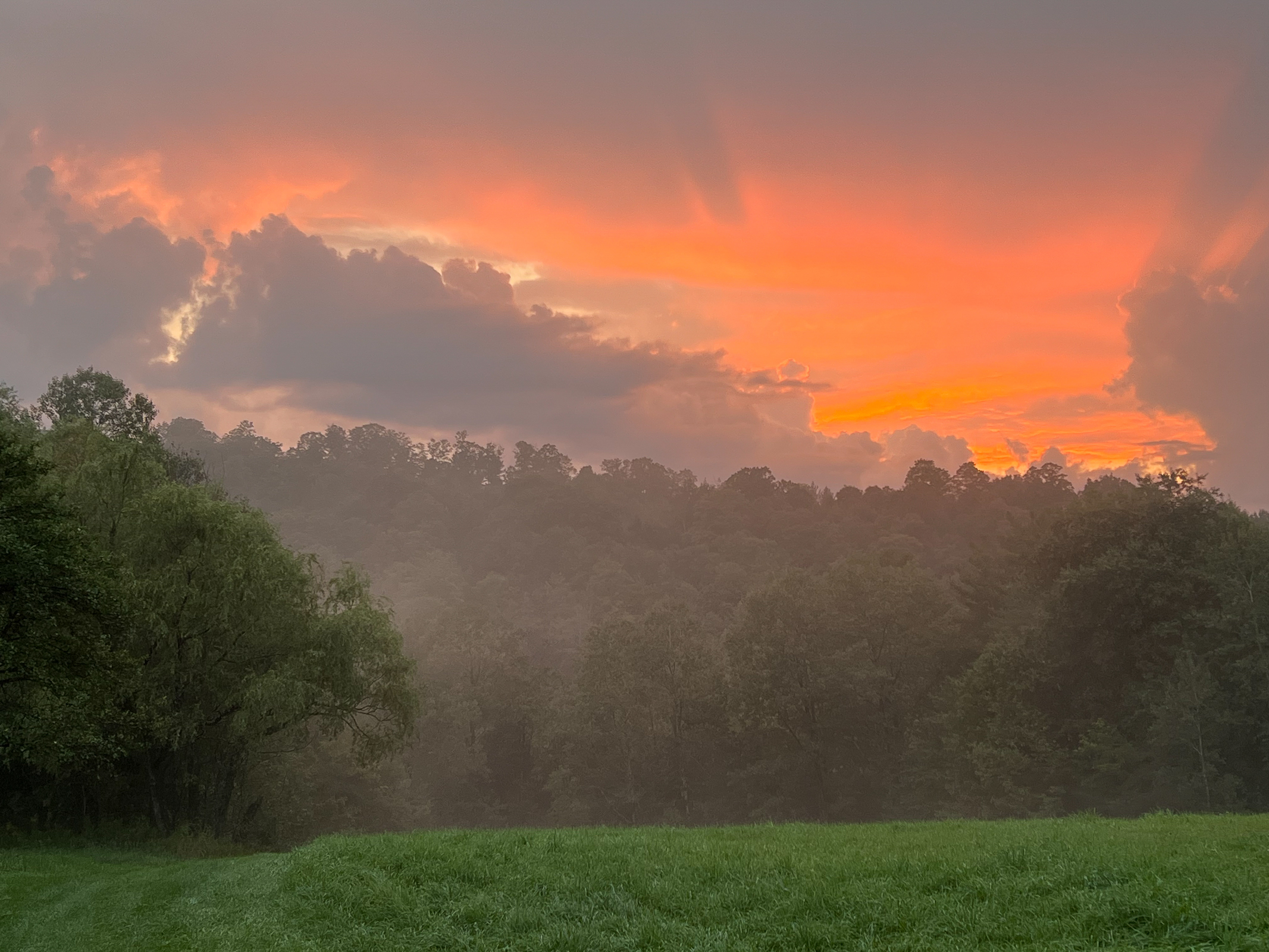
After everyone left, we had the time to observe the small things that mark the time between visits with friends and family and Presidential elections. For a moment, the pounding rain outside turned to hail and piled up like snow before quickly melting. The sky burned red over the fog left by the rain and New England’s recent summer drought seemed broken.
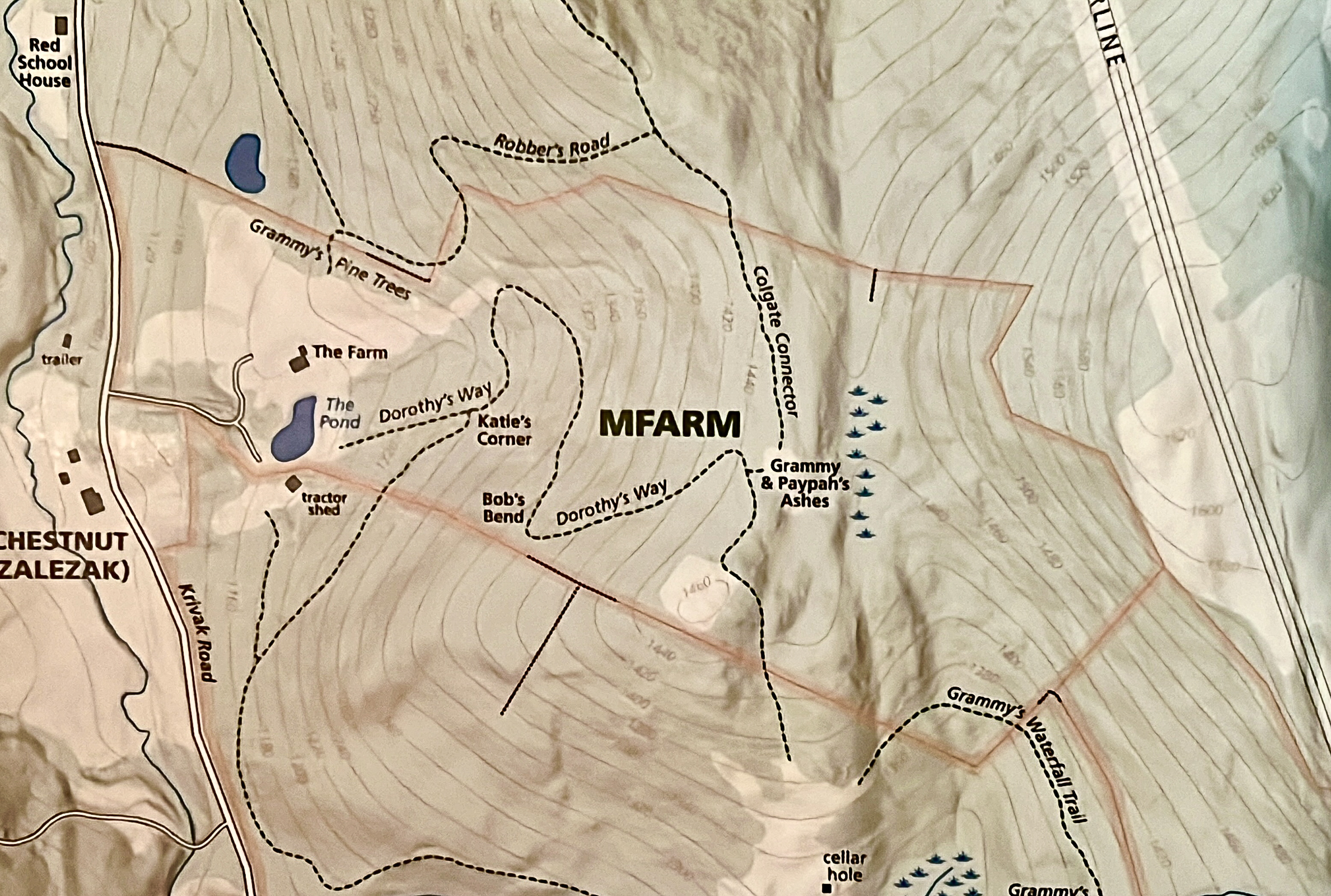
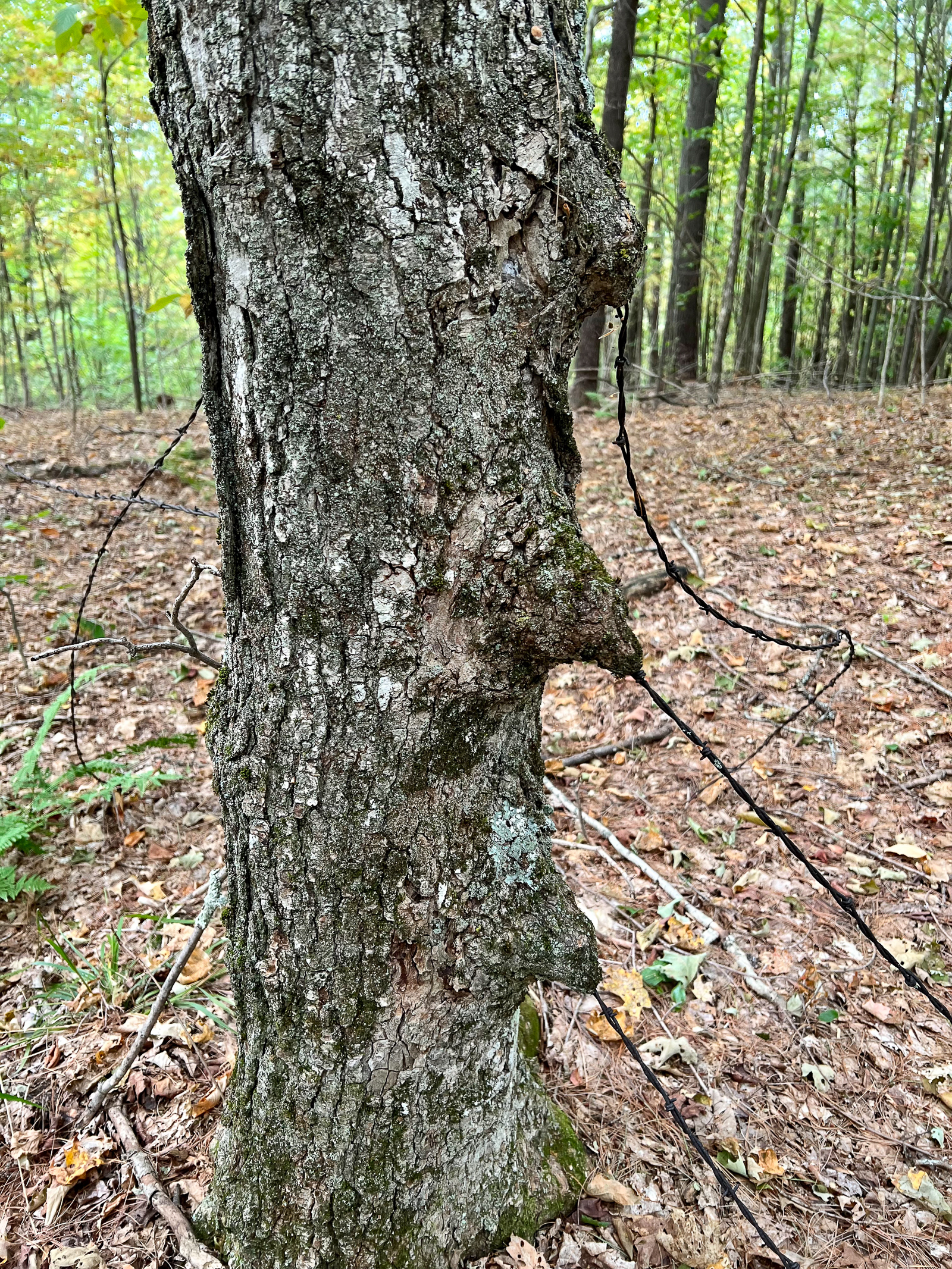
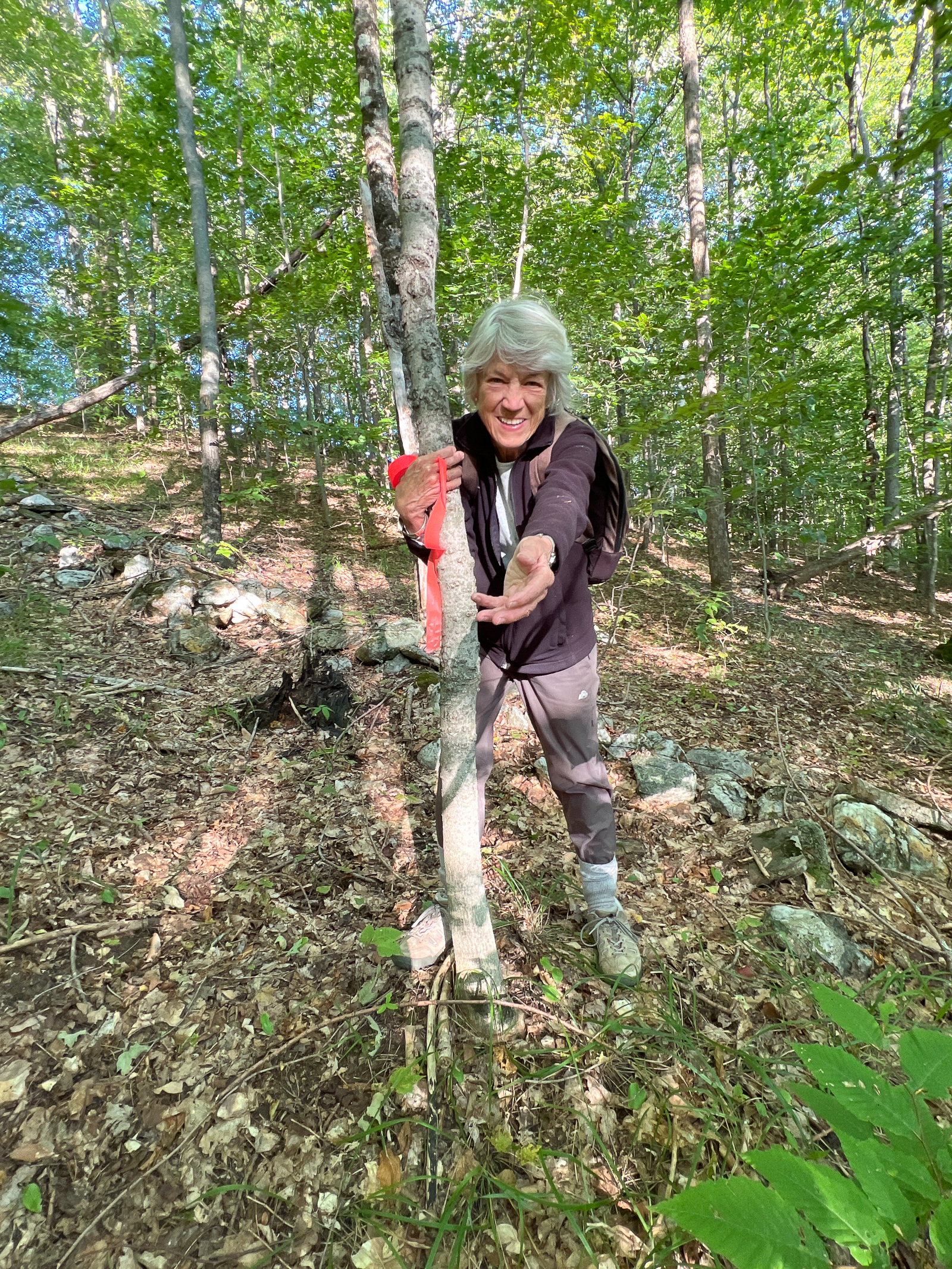
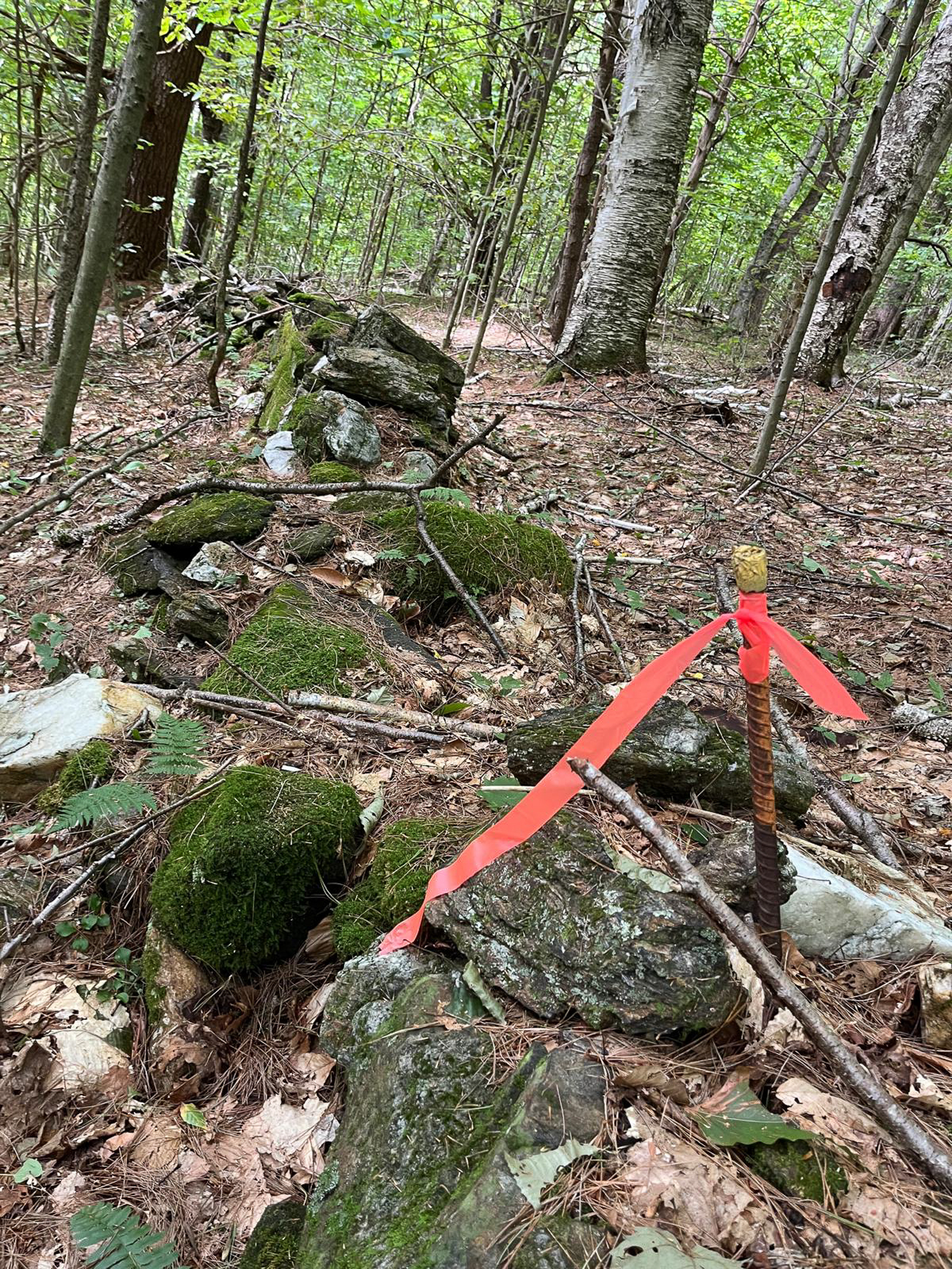
One of the projects that Ellen and I did together was to walk, mark, and map the property line all the way around our 53 acres. It took many days to complete, and it was one of the most inspiring and satisfying projects that we have done here at the Farm. We spent our time following lines on a two-dimensional map in a three-dimensional forest. We were aided by a professional map of the property made by our nephew Bart as well as old property deed maps and aerial photo maps. Sometimes, we were aided by discovering old stone walls that followed the property lines. We guessed that some of these walls were, possibly, 200 years old. Barbed wire replaced some of the stone walls in the latter part of the 19th century and often, we would find old trees that had grown around the wire.
An additional challenge was the terrain itself. This part of Vermont is very hilly and hiking this lumpy landscape required strong legs and a lot of motivation. Fortunately, we’re from hilly San Francisco and we hike there every day. Sometimes, we had to ski down the dirt slopes on our shoes and help each other up on the other side. Astonishingly, the people that built these 19th century stone walls didn’t seem intimidated by the steep hills and vertical canyons of Vermont. Hiking these walls gave us a little more insight into the rugged lives of these early Vermont farmers.
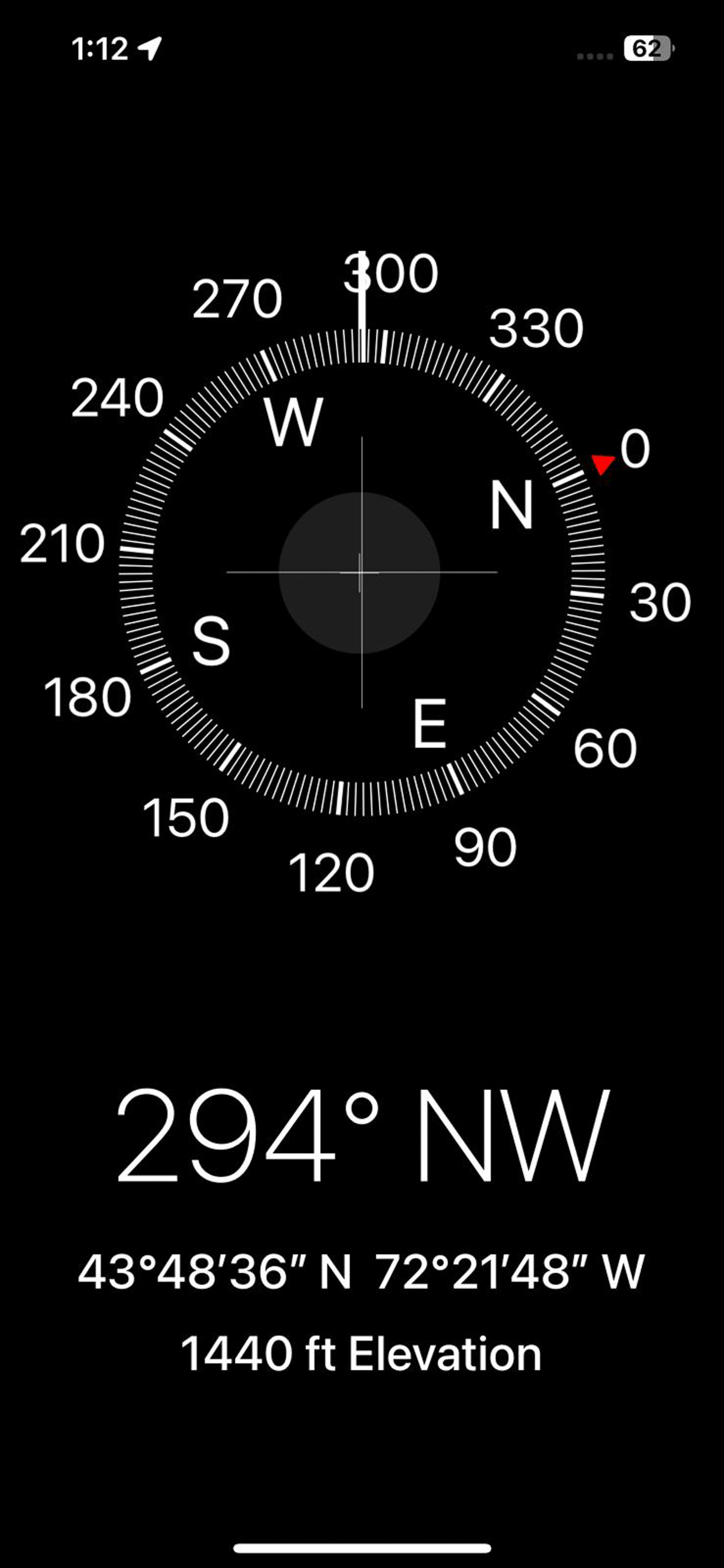
We were helped by having good maps and a compass on our phones which allowed us to accurately wander the hills and valleys without getting lost. We were also aided by the app GaiaGPS which allowed us to map our route while being offline. Pink ribbon was how we marked our way on this incredible journey.
Screenshot
As we followed the lines of the property, we were also following lines of history and geography. We deepened our own connection to this place by our current journey over it which also helped us better understand its buried past. As we made our way across the landscape, we also became more a part of it. The land itself became our teacher and our roaming became our solace.
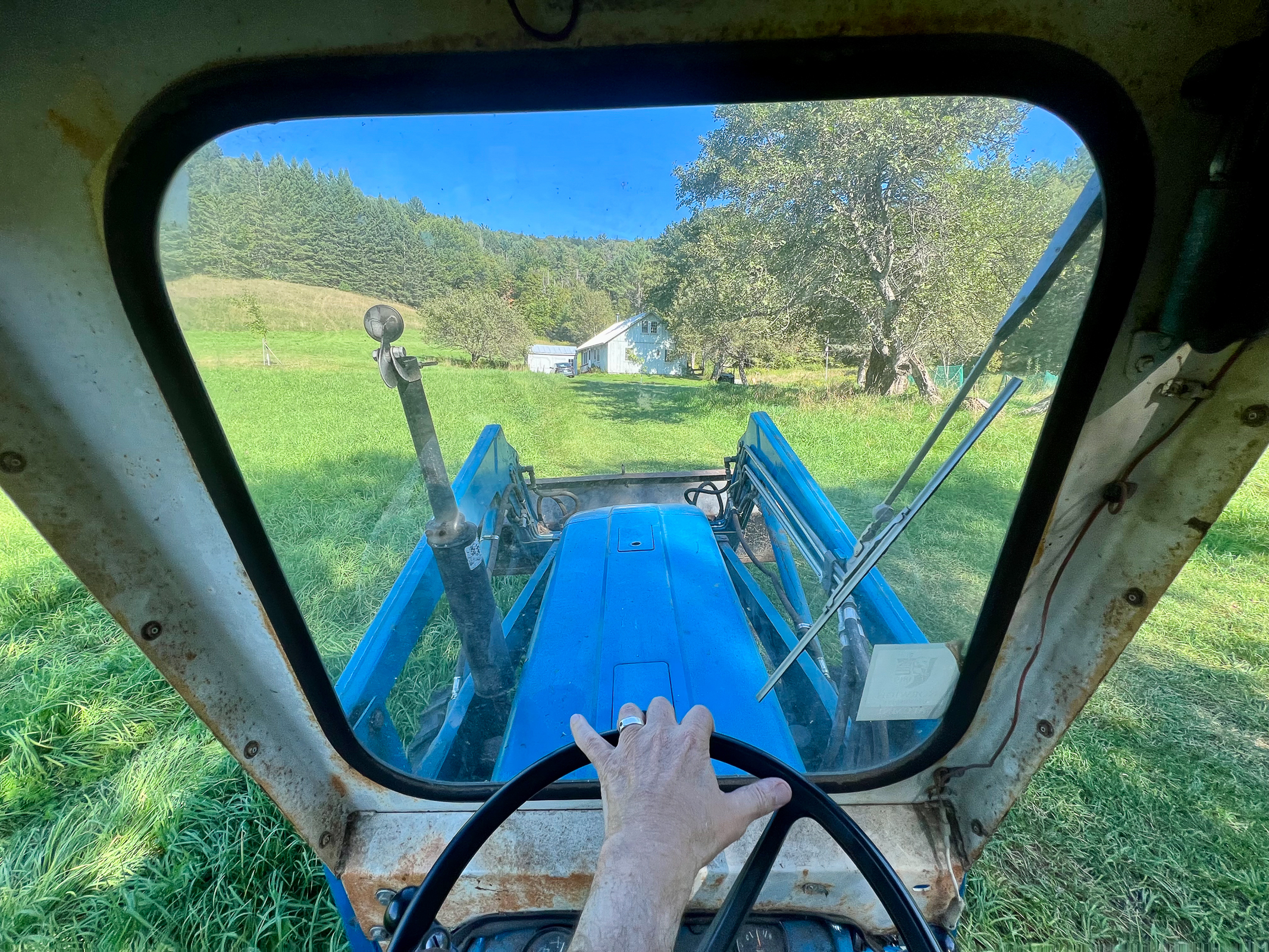
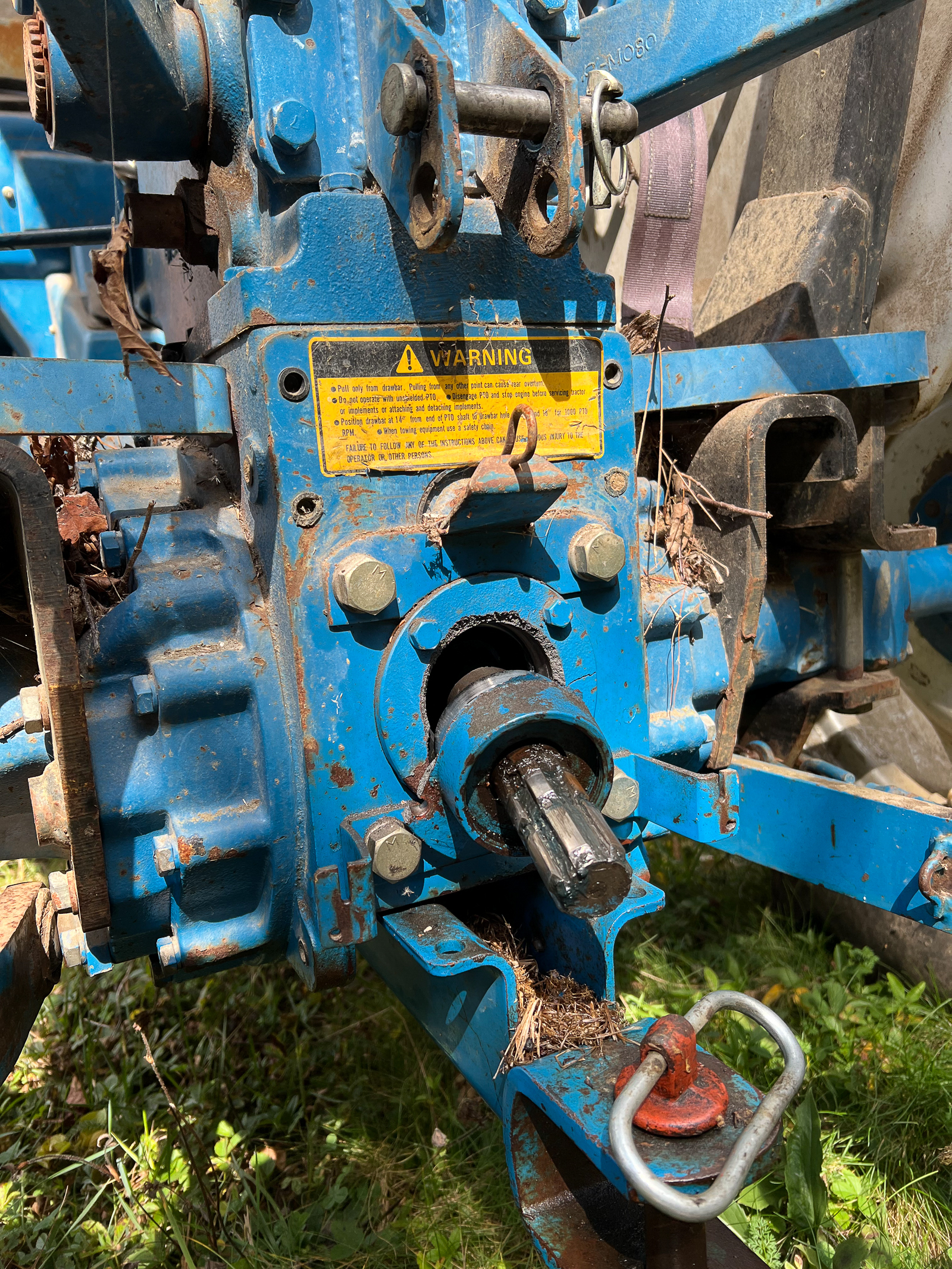
When Ellen’s brother John visited, we quickly got to work doing the chores that need to be done to keep our place going. John taught me how to drive his old tractor and cut the grass in one of the outlying fields. It took more than an hour to do this as the tractor traveled at a very sedate pace fitting its ancient age. I really enjoyed doing that chore as it gave me time to think about the dignity of manual labor, the separation in our country between people working with their hands versus people who work on their screens, Presidential politics, and what to make for dinner that night. Unfortunately, the next time I fired up the tractor, a coupling in the back broke and leaked out all the hydraulic fluid, ending that chore. Undeterred, I jumped on the old sit-down lawn mower to continue mowing but after a few minutes it stopped dead in its tracks with a broken belt. At that moment, I decided I was through with breaking things and went off to read a book.
Between chores, reading, and hiking, we were lucky to have several visitors throughout our time at the Farm. We see Virginia and Michael every year as they live near Hanover, NH. We had a small party at our place celebrating her retirement from teaching photography for many years at Dartmouth College. They brought their friend and celebrated journalist/ war photographer Jim Nachtwey. His career has spanned the globe over decades and the conversation that night was epic. We feel lucky to know them all.
A few days later, Ellen’s best friend from first grade, Deb, flew in with her husband Elliot. She is a retired professor, and he is still a practicing eye doctor who flew his own plane from Rhode Island. We had a non-stop conversation with them for two days and enjoyed every minute of it.
Finally, we first met our friend Lisa during our Fulbright Fellowship in Jerusalem in 2019. She was a US diplomat working at the American embassy and has recently retired. She took a 10-hour train ride from her home in Washington, DC up to Vermont and we spent four days hiking, cooking, site seeing, talking world events and politics, and never running out of fascinating things to discuss.
We only got the internet at the Farm last year. Although we resisted it for a long time, it was a good addition because it allowed us to watch Kamala Harris put down the bully Trump in an amazing political event. This will be the only Presidential debate, and it was good to see how much of a looser he really is. So much depends on this election, but that night Kamala made us proud.
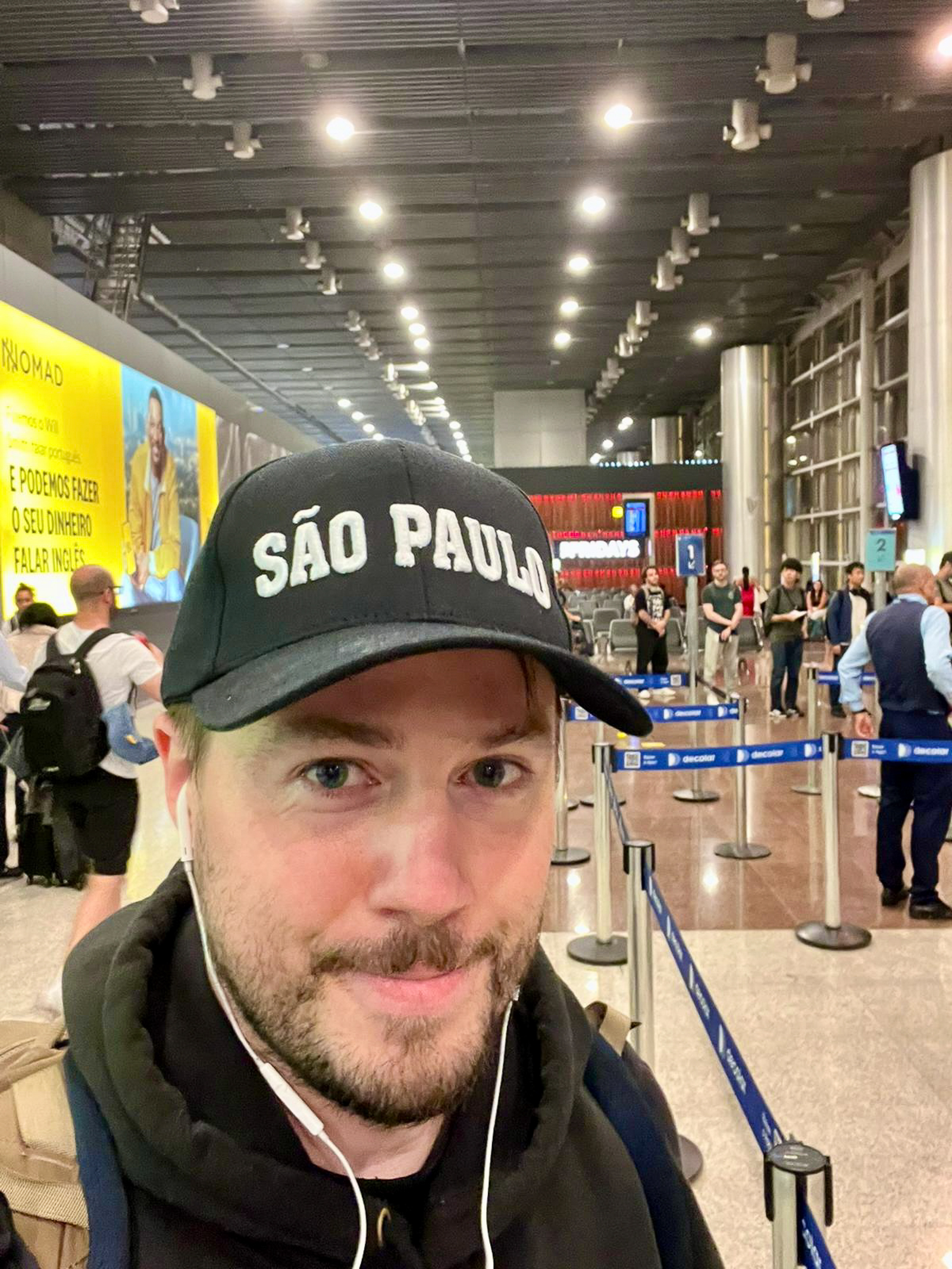
Since Walker’s recent visit to the Farm, he has been on assignment for CBS in Alaska (twice), on the border with Mexico, and in Brazil covering a newly discovered slave ship story. Fortunately, we stay in touch and follow his amazing globetrotting adventures.
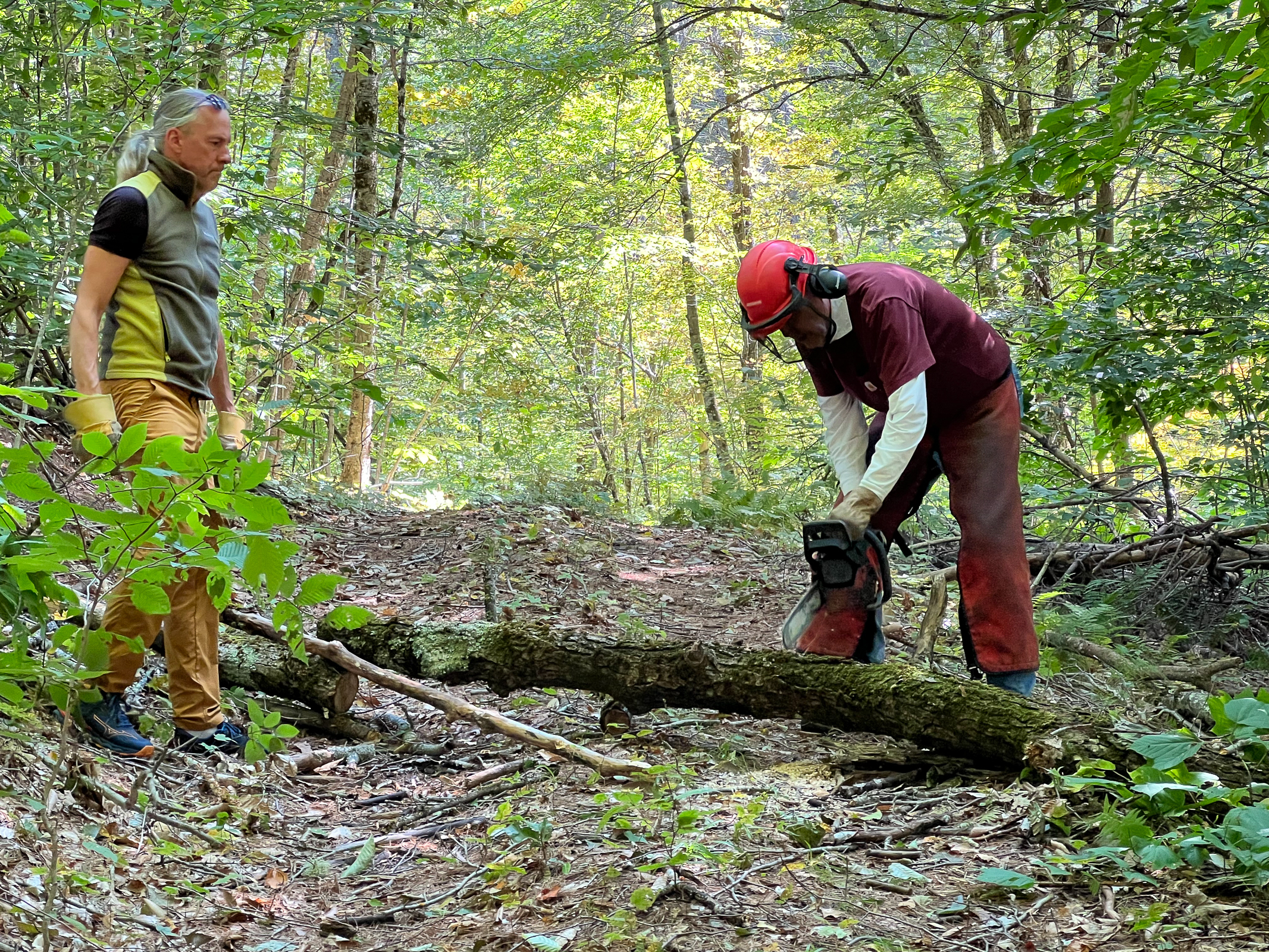
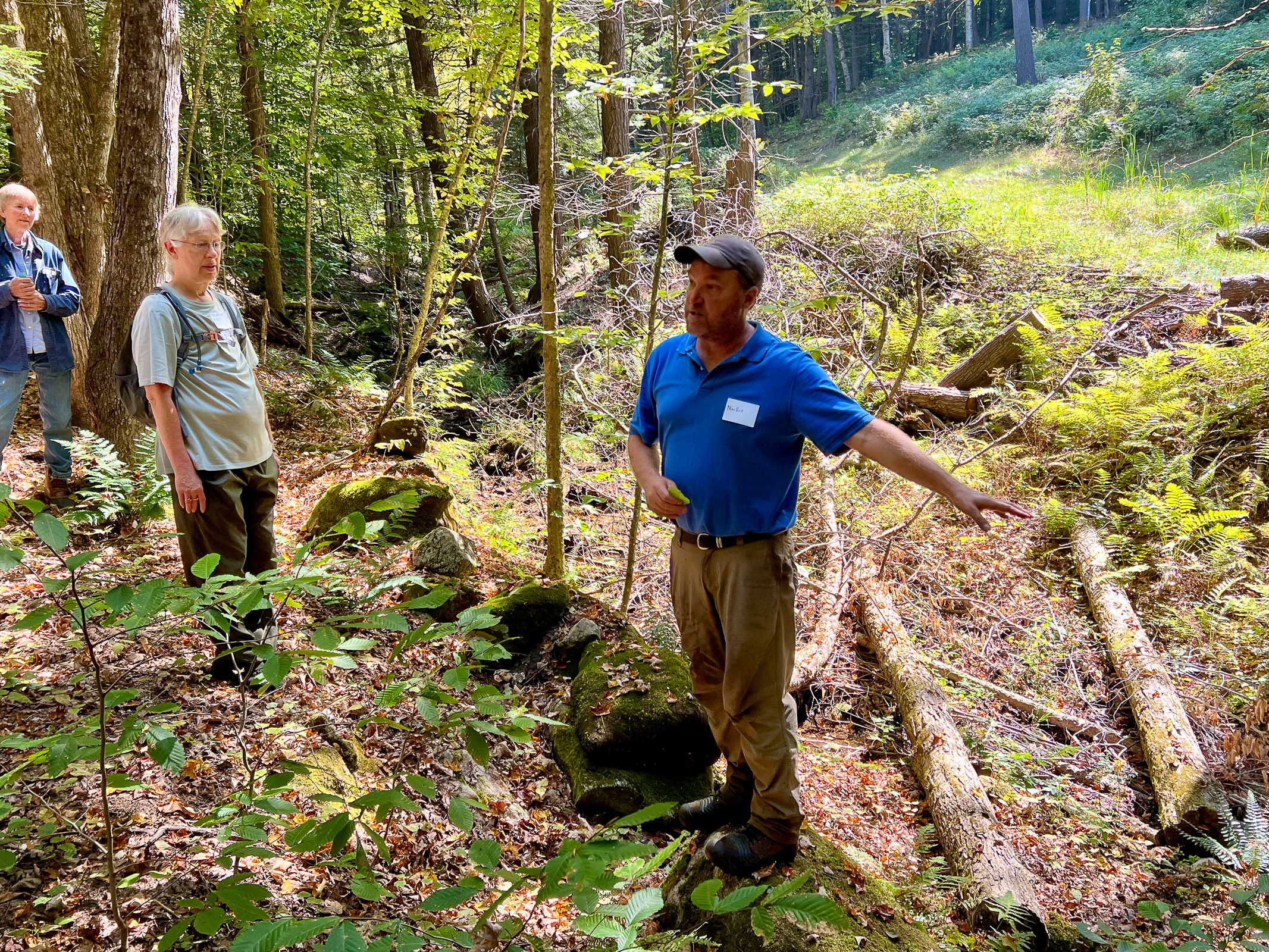
The chores never end at the Farm. But one of the benefits is that it gives us a chance to spend time with Ellen’s brother John. Cutting trees and planting trees is a non-stop necessity. John is part of a group called the Vermont Woodlands Association which helps Vermont landowners conserve their forests. We held another delightful Walk in the Woods event with a group of neighbors highlighting John’s sustainability work on his property.
As we were nearing the end of September, the Autumn colors were appearing in the Vermont forests. Soon the leaf peepers would be out in force and the backcountry roads would be thick with tourists. After this long and delightful stay, we experienced the hardest time leaving. After bonding so completely this time with this rural place, it would be difficult to drive back through the corporate American road culture to California. But fortunately, along the way we have several friends we will meet and miles to go before we sleep.
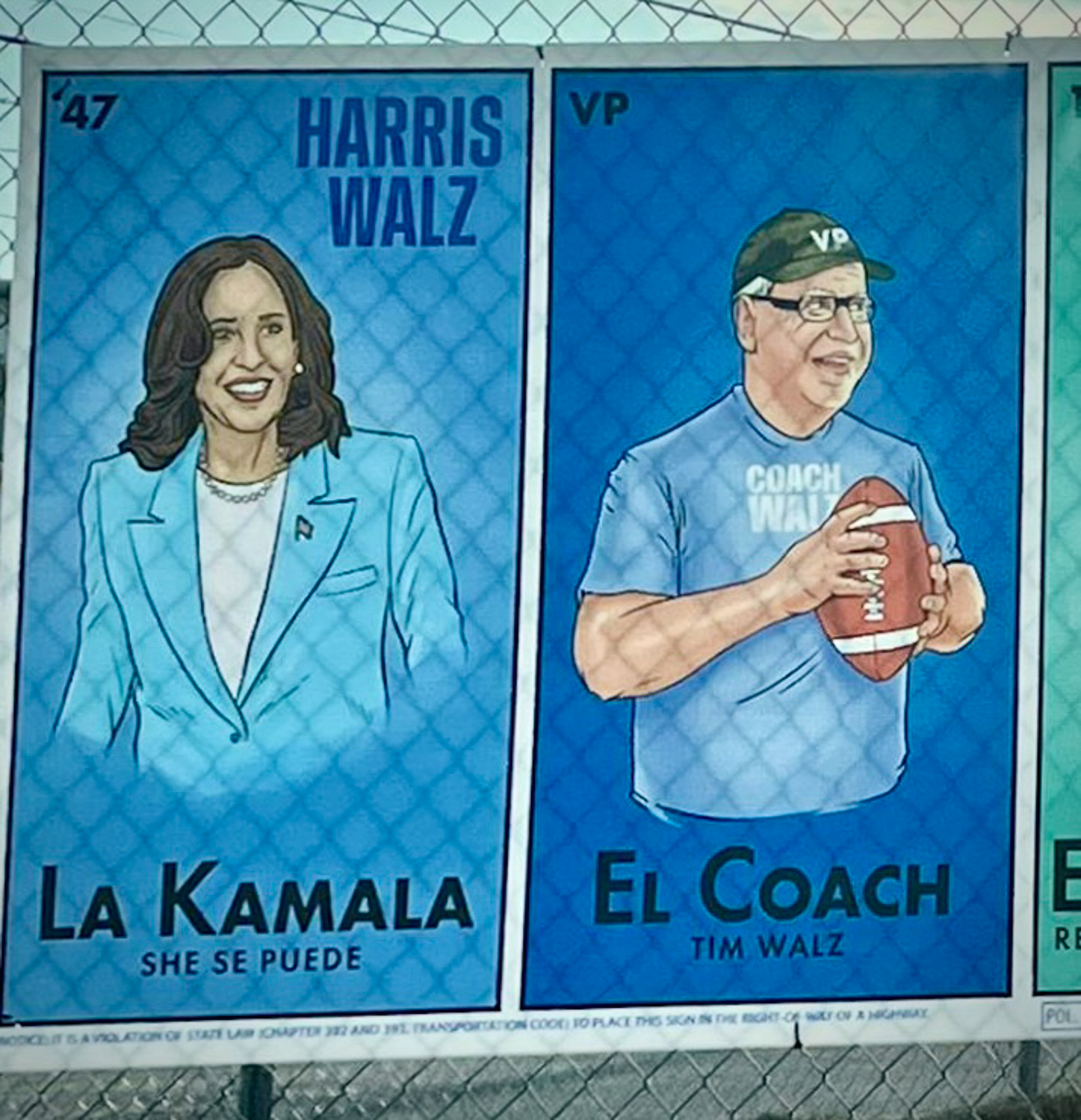
We postponed our departure by one day to watch the Vice-Presidential debate between Tim Walz and JD Vance. I think Vance was a better debater but there was no question that Walz should become the next VP. To be continued…
I'm photographer Robert Dawson. Join me and my son, Walker, as we drive across the country this summer photographing public libraries for my next book, due out in 2013. Our trip will complete 17 years of field work documenting this precious American resource.
For more on my work and my upcoming American Public Library photography book, please visit robertdawson.com.










































 Library Road Trip